
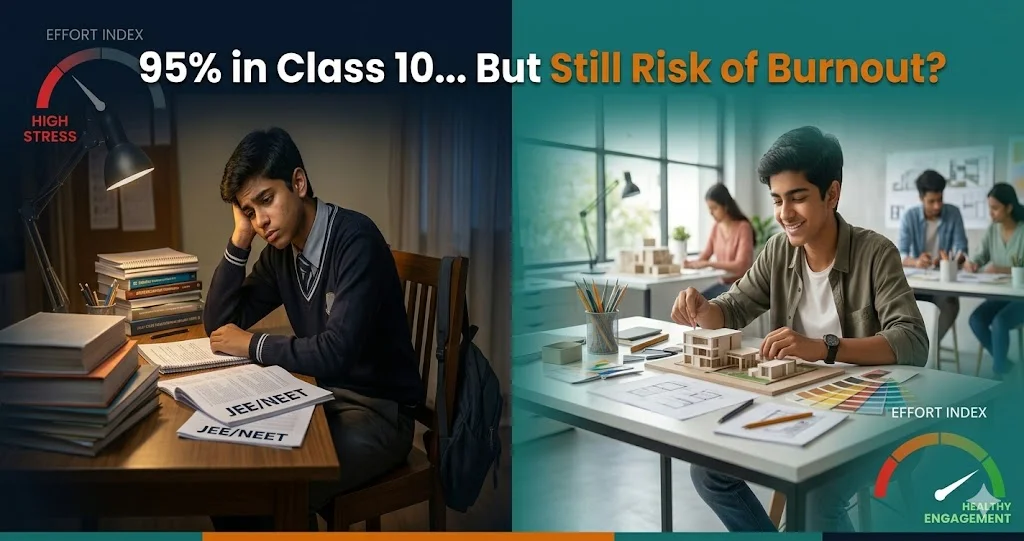
High marks in Class 10 do not guarantee career success or happiness. Many Indian students who score 90%+ face burnout, dissatisfaction, or dropout in college because their natural aptitudes and personality traits were never matched to their career path — only their board percentage was.
- Board marks test memory and hard work — not the 7 natural aptitudes that predict career fit
- The Effort Index reveals whether a career will feel like flowing downstream or swimming upstream
- 85% of India’s 1.5 million engineering graduates annually struggle to find relevant work — often due to aptitude mismatch
- A psychometric assessment before stream selection is the single most impactful career decision a family can make
The Hidden Crisis Behind High Board Marks
Board exams test memory, hard work, and exam technique — valuable skills, no doubt. But they do not measure what matters for long-term career success: your child’s natural cognitive strengths and personality traits.
In 2026 India, we produce around 1.5 million engineering graduates every year. Yet reports consistently show that nearly 85% of them struggle to secure relevant job offers. Many end up underemployed, switching fields, or experiencing burnout within the first 3–5 years of their careers. Why? Because thousands of high-scoring students are pushed into PCM or engineering not because it fits them, but because “marks allow it.” They spend years swimming upstream — working twice as hard as others just to stay afloat. The result is chronic stress, anxiety, loss of motivation, and eventual burnout.
I have counselled many Class 12 students who topped their schools in Class 10 but now dread going to JEE coaching. Their parents are shocked: “But beta, you were always a topper!” What changed? Nothing changed in their effort — what was revealed is a mismatch between their natural profile and the demands of the stream. This is not laziness or lack of intelligence. It is a fundamental misalignment that board marks simply cannot detect.
What the Effort Index Actually Measures
At Career Ka Doctor, we use a proprietary Effort Index — a science-based metric that shows how much effort your child will need to invest in a particular career path relative to their natural strengths.
Think of it like this: Flowing downstream means the career feels natural. Your child leverages their strengths daily, achieves more with less stress, and sustains motivation for decades. Swimming upstream means constant struggle — even with hard work, progress feels exhausting, leading to frustration and burnout.
The Effort Index is calculated using two core components from a validated psychometric assessment:
- 7 Aptitude Types (fixed by age 14): Abstract Reasoning, Numerical, Verbal, Spatial, Mechanical, Linguistic, and Operational
- 28 Personality Traits: Including Openness, Conscientiousness, Emotional Stability, Aesthetic Sensitivity, Persistence, and more
We score careers in three tiers: 🟢 Lesser Challenge (natural fit — success feels energising), 🟡 Moderate Challenge (achievable with focused effort), and 🔴 High Challenge (constant uphill battle, high risk of dissatisfaction). A student with 95% in Class 10 but only moderate Numerical Aptitude and low Mechanical Aptitude may still get into a good engineering college through coaching. But their Effort Index for core engineering roles will be high. They will spend college years compensating for weaknesses instead of building on strengths.
Real Indian Student Stories of Mismatch
Here are three anonymised stories from families we have guided — each one a high scorer who found themselves in the wrong stream:
Rahul’s Story — Delhi, Class 10: 96%
Rahul scored exceptionally well and took PCM. His parents were thrilled — IIT dreams were alive. But his psychometric profile showed high Verbal and Linguistic Aptitude, moderate Numerical, and high Openness with low Operational traits. Engineering felt like torture. He cleared JEE but dropped out after first year, battled depression, and later found his flow in content strategy and digital communication. Today he earns well and feels alive — but lost two precious years and significant family savings.
Priya’s Story — Bangalore, Class 10: 94%
Strong in Maths on paper, but her assessment revealed high Spatial and Aesthetic Sensitivity with moderate Abstract Reasoning. Forced into engineering, she struggled with coding and abstract theory. High Effort Index led to anxiety attacks. She switched to architecture after Class 12 — a field where her spatial strengths shine. Now in her third year, she says, “I finally feel I am studying for myself, not just for marks.”
Arjun’s Story — Hyderabad, Class 10: 95%+
Pushed into CSE with high Mechanical and Operational aptitude but lower Numerical endurance for pure coding marathons. Burnout hit in second year. After assessment-guided pivot, he is now thriving in robotics and automation — a field that perfectly matches his natural profile.
These are not rare cases. Across 23+ partner schools and thousands of one-on-one sessions, we see this pattern repeatedly. High marks create an illusion of unlimited options, but without data on natural fit, many families unknowingly choose high-effort paths.
How a Validated Psychometric Assessment Reveals the Truth
A proper psychometric assessment is not an online quiz or interest inventory. It is a scientifically validated tool that measures innate abilities and traits — things coaching or board exams cannot reveal.
Our process begins with a 45–60 minute online assessment (no preparation needed) that evaluates the full spectrum of 7 aptitudes and 28 personality traits. The outcome is a detailed 60+ page personalised career report that includes a deep aptitude and personality profile, the Effort Index ranking for different career paths, 3 best-fit career recommendations with roadmaps, blind spots and development areas, and stream selection guidance aligned with family realities.
This is not guesswork. It is objective data that removes emotional bias and family pressure from the equation. Parents often tell us after receiving the report: “We finally understand why certain subjects felt easy and others draining for our child.” The assessment is particularly powerful before or right after Class 10 — when stream choices are still flexible and the pressure has not yet reached its peak.
The Career Ka Doctor Approach to the Effort Index
Career Ka Doctor’s Effort Index is built on 25+ years of guiding 5 lakh+ students across 120+ cities in India and 4 countries. It is the only career metric in India that simultaneously maps both aptitude alignment and personality alignment to produce a single, honest score for any given career. Learn more about how the assessment works, or book a free consultation to see your child’s profile.
Children whose career choices align with their Effort Index profile show dramatically higher satisfaction, lower stress, and faster professional growth — even when they do not take the most prestigious route. You do not need to force your child into a mould that does not fit. You need clarity on the unique mould they were born with.
Career Ka Doctor’s complete assessment — 60+ page personalised report + expert counselling session with Ameen Mudassar — gives you data, not guesswork. Book a free consultation on WhatsApp today:
Frequently Asked Questions
Can a child with 95% in Class 10 still do well in engineering?
Yes — if their aptitude profile supports it, specifically strong Numerical and Abstract Reasoning aptitude. The Effort Index will clearly show this. Many toppers thrive in engineering when the natural fit is genuine, not just marks-based.
Is it too late if my child is already in Class 11?
Never too late. While the stream is locked, the assessment still helps choose the right specialisation, colleges, and backup career plans that minimise future struggle. Many students in Class 11 and 12 benefit enormously from late-stage clarity.
How accurate is a psychometric assessment for career guidance in India?
Our validated psychometric assessment has been used to guide 5 lakh+ students across India and 4 countries. Aptitudes are neurologically fixed by age 14 and remain stable for life, making them highly reliable predictors. The 28 personality traits provide additional depth for long-term career satisfaction.
What if the report suggests a non-traditional career path?
Every career recommendation in the 60+ page report includes practical realities — salary ranges, growth trajectory, entrance exams, and college options in India. The goal is always informed, practical choice that balances natural fit with family values and financial expectations.
How is Career Ka Doctor’s assessment different from school career counselling in 2026?
School counsellors do valuable work, but most do not have access to a deep 7-aptitude and 28-personality-trait assessment with a personalised Effort Index for each student. Career Ka Doctor’s 60+ page report provides individual, data-driven clarity that standard school guidance programmes cannot match.
At what age or class should my child take the psychometric assessment?
The ideal time is Class 8 to Class 10 — before stream selection pressure peaks. However, students in Class 11, Class 12, or even early college have benefited from late-stage assessment to course-correct with data rather than guesswork.