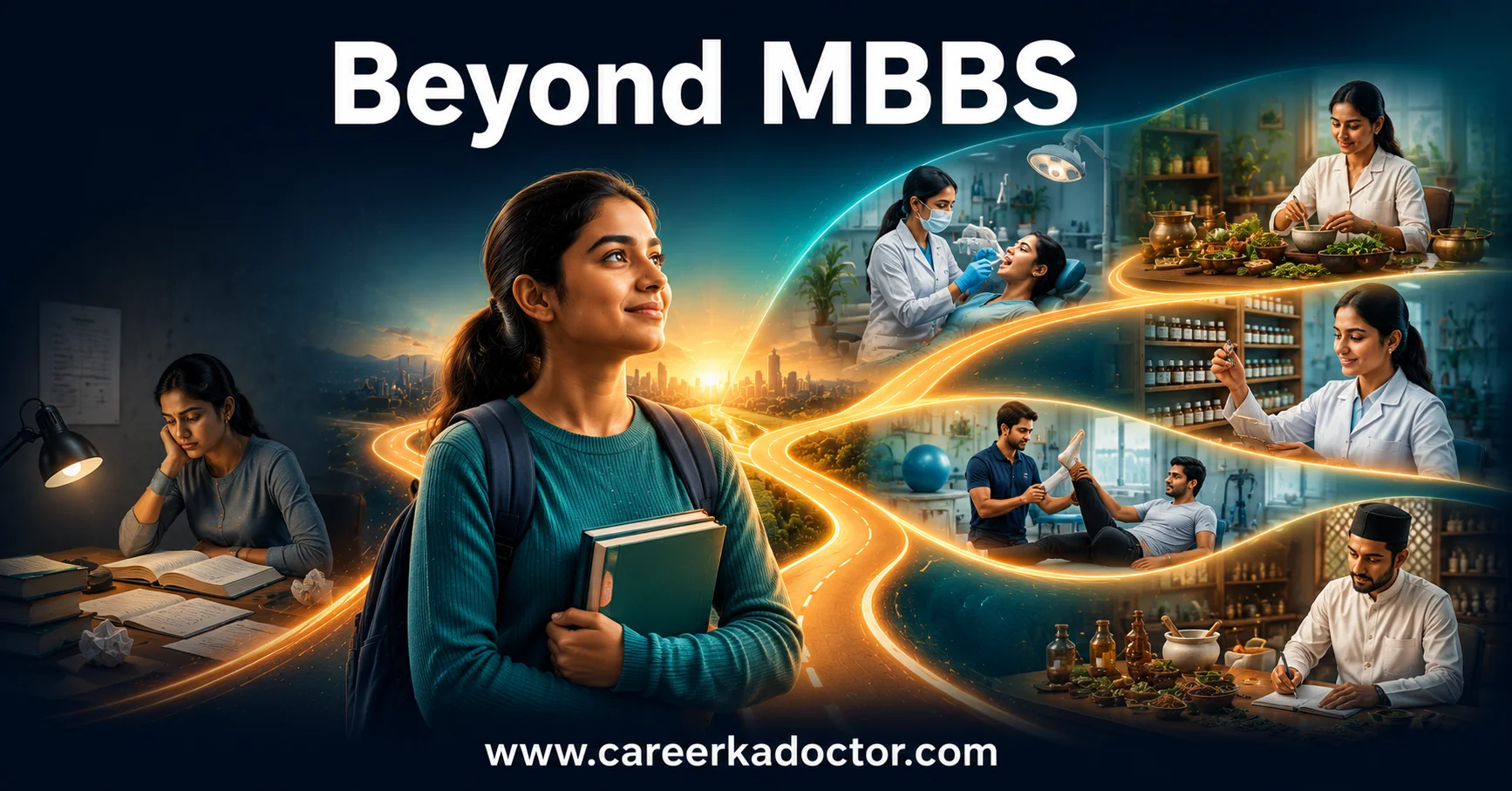
Alternative medicine courses after NEET 2026 include BDS (Dentistry), BAMS (Ayurveda), BHMS (Homeopathy), BUMS (Unani), and BNYS (Naturopathy), all of which accept NEET UG scores for admission and offer legitimate, rewarding healthcare careers. These aren’t “backup” options. For many students, they’re a better natural fit than MBBS, especially when the aptitude profile and personality traits align with what these professions actually demand day to day.
- BDS, BAMS, BHMS, BUMS, and BNYS all require NEET UG scores, but cutoffs are significantly lower than MBBS, often in the 300–450 range for government seats.
- Each course suits a different aptitude profile. BDS demands high spatial ability, BAMS needs strong verbal and linguistic skills, and BNYS fits students with an operational and interpersonal bent.
- AYUSH careers after NEET India are growing fast. The government’s AYUSH ministry budget crossed ₹3,600 crore in 2024-25, signalling long-term institutional support.
- Choosing the right alternative medicine path based on psychometric data, not just available seats, dramatically reduces the risk of mid-career regret.
Why Consider Alternative Medicine Courses After NEET 2026?
Every year, around 20 lakh students appear for NEET UG. Roughly 1.1 lakh MBBS seats exist across India. The math is brutal. But here’s what most families don’t realise: the students who thrive in BDS, BAMS, or BHMS aren’t the ones who “couldn’t get MBBS.” They’re the ones whose natural strengths actually match these fields.
I’ve seen a student from Pune who scored 480 in NEET and was heartbroken about missing MBBS. She took BAMS, discovered a genuine passion for Panchakarma therapy, and now runs a successful integrative wellness clinic earning over ₹1.2 lakh a month. Her story isn’t unusual. The problem isn’t the career. The problem is how we frame these options as consolation prizes when they’re not.
The Indian government’s push through the National AYUSH Mission, integration of AYUSH practitioners into primary health centres, and growing global demand for holistic medicine make these paths genuinely viable. But viability alone shouldn’t drive your decision. Aptitude fit should.
BDS (Bachelor of Dental Surgery): Course Details, Cutoffs, and Career Scope
What BDS Involves
BDS is a 5-year programme (4 years of study plus 1 year of compulsory internship). You’ll study general anatomy, physiology, and biochemistry in the first two years, much like MBBS. From the third year, the focus shifts to dental materials, oral pathology, orthodontics, prosthodontics, and oral surgery. There’s a significant hands-on component. You’re working with your hands inside a very small space, which requires fine motor skills and strong spatial reasoning.
Admission Cutoffs and Fees
For government dental colleges, expect NEET cutoffs in the range of 450–520 (General category) depending on the state. Private colleges may admit students scoring 350–400. Government college fees range from ₹20,000 to ₹5 lakh for the entire course. Private colleges can charge ₹8–25 lakh total.
Career Scope and Earning Potential
A fresh BDS graduate can expect ₹25,000–₹50,000 per month as an associate in a dental clinic. After 3-5 years of experience or an MDS specialisation, earnings jump to ₹80,000–₹2.5 lakh monthly. Private practice is where the real money is. A well-located dental clinic in a Tier 2 city can generate ₹4–8 lakh monthly revenue.
Who Should Choose BDS?
Students with high spatial aptitude and strong operational ability tend to do very well in dentistry. If your child enjoys working with their hands, has patience for precise, repetitive tasks, and doesn’t mind a narrow physical workspace, BDS is worth serious consideration. Verbal aptitude matters too, because patient communication is a daily reality.
BDS BAMS BHMS After NEET 2026: AYUSH Courses Compared
BAMS (Bachelor of Ayurvedic Medicine and Surgery)
BAMS is a 5.5-year programme including a 1-year internship. The curriculum blends modern anatomy, physiology, and pharmacology with classical Ayurvedic texts like Charaka Samhita and Sushruta Samhita. You’ll study Sanskrit terminology extensively, which is why linguistic aptitude matters here more than in any other medical course.
NEET cutoffs for government BAMS seats typically fall between 350–450 (General category). Fees at government colleges are remarkably affordable, often ₹15,000–₹1 lakh per year. Career options include working in AYUSH hospitals, setting up a private Panchakarma or wellness clinic, joining the pharmaceutical industry (Ayurvedic product development), or even pursuing research. A practising BAMS doctor in a metro city can earn ₹40,000–₹1.5 lakh per month, with established practitioners earning considerably more.
BAMS suits students with strong verbal and linguistic aptitude who genuinely enjoy reading, memorising, and interpreting classical texts. A student who finds biology fascinating but also has an inclination towards literature or languages will find BAMS intellectually satisfying in ways MBBS won’t offer.
BHMS (Bachelor of Homeopathic Medicine and Surgery)
BHMS is also a 5.5-year programme (4.5 years + 1 year internship). The course covers human anatomy, physiology, and pathology alongside homeopathic philosophy, Materia Medica, Organon of Medicine, and repertory. What makes homeopathy unique is the emphasis on individualised patient assessment. You’re not just treating a disease. You’re understanding the whole person.
NEET cutoffs for BHMS are generally lower, around 300–400 for government seats. Fees at government institutions are minimal. Career paths include private practice (very common in states like West Bengal, Kerala, and Maharashtra), hospital positions, and the booming homeopathic pharmaceutical industry. Earnings start around ₹25,000–₹40,000 monthly and can reach ₹1–2 lakh with established practice.
BHMS is ideal for students with high verbal aptitude combined with strong abstract reasoning. The ability to see patterns in patient symptoms and connect them to remedy profiles requires a mind that thinks in connections and associations, not just linear cause-and-effect.
BUMS (Bachelor of Unani Medicine and Surgery)
BUMS is a 5.5-year programme focused on Unani medicine, a Greco-Arabic system that emphasises the balance of four humours. The medium of instruction often includes Urdu, and classical texts are studied in Arabic and Persian. This makes BUMS particularly suited for students from backgrounds where these languages are familiar.
Cutoffs are among the lowest in the medical field, often 250–350 for government seats. Career scope includes government AYUSH dispensaries, private practice, and herbal pharmaceutical companies. Earning potential is similar to BHMS, starting at ₹20,000–₹35,000 monthly and growing with experience and reputation.
The aptitude profile for BUMS mirrors BAMS in many ways: strong linguistic and verbal ability is essential. But BUMS also benefits from students with high interpersonal personality traits, since Unani practice is deeply rooted in detailed patient history-taking and lifestyle counselling.
BNYS (Bachelor of Naturopathy and Yogic Sciences)
BNYS is a 5.5-year programme that combines modern medical sciences with naturopathic treatments, yoga therapy, diet therapy, hydrotherapy, and mud therapy. It’s the most “wellness-oriented” of all the options here. Some colleges, like SDMCNYS in Ujire (Karnataka) or Government Yoga and Naturopathy College in Chennai, are well-regarded.
NEET cutoffs range from 250–380 for government seats. Career opportunities are expanding rapidly in the wellness tourism sector, corporate wellness programmes, yoga therapy centres, and integrative medicine hospitals. Starting salaries range from ₹20,000–₹35,000, but entrepreneurial graduates who open wellness centres or become wellness consultants can earn ₹80,000–₹2 lakh monthly within 5 years.
BNYS suits students with strong operational aptitude and a genuine interest in lifestyle medicine. If your child is the kind who’s naturally drawn to fitness, nutrition, and holistic health, and also has decent interpersonal skills, this could be an excellent fit. I’ve noticed that students who feel “bored” by the idea of sitting in an OPD all day but love active, hands-on therapeutic work do really well in BNYS.
AYUSH Careers After NEET India: The Government Push and Market Reality
The Ministry of AYUSH has been steadily expanding its footprint. There are now over 4,000 AYUSH hospitals and 28,000 dispensaries across India. The National Education Policy 2020 encourages interdisciplinary integration of AYUSH with modern medicine. And globally, the wellness industry is projected to cross $7 trillion by 2025, with India positioned as a key player in Ayurveda and Yoga exports.
But I want to be honest with parents: not all AYUSH careers offer the same social prestige or starting salary as MBBS. That’s a reality. The question you need to ask is whether your child will be happier and more successful in a career that matches their natural aptitude, even if the starting salary is lower. In my experience, the answer is almost always yes. A mismatched MBBS graduate who dislikes clinical work earns less in the long run than a well-matched BAMS practitioner who builds a thriving practice with genuine passion.
Government job opportunities exist through UPSC, state PSCs, and railway medical services, all of which now recruit AYUSH practitioners. And with the WHO’s growing focus on traditional medicine systems, international career opportunities are opening up in countries like Germany, Australia, and the Middle East.
How to Choose the Right Alternative Medicine Course: Aptitude Matters More Than Cutoffs
Parents often ask me, “Which is better, BDS or BAMS?” That’s the wrong question. The right question is, “Which one fits my child’s natural strengths?”
A student with high spatial and mechanical aptitude will find BDS exciting because of the precision handwork involved. But put that same student in BAMS, which requires hours of memorising Sanskrit texts, and they’ll struggle not because they’re not smart, but because the work demands a completely different cognitive profile.
Similarly, a student with strong abstract reasoning and pattern recognition might find BHMS intellectually stimulating in a way that BDS never could. And a student with high operational aptitude and a people-oriented personality might find their calling in BNYS, even though it’s the least “prestigious” option on paper.
The biggest mistake I see families make is choosing based on cutoff availability rather than aptitude fit. A student who secures a BDS seat because the cutoff was within reach, but whose aptitude is actually better suited to BAMS or BNYS, often ends up dissatisfied and sometimes even drops out by the third year. That’s a waste of time, money, and emotional energy.
The Career Ka Doctor Approach to NEET Guidance
This is exactly where data-driven career counselling makes a real difference. Career Ka Doctor uses a validated psychometric assessment that measures 7 aptitude types (Abstract, Numerical, Verbal, Operational, Mechanical, Linguistic, and Spatial) alongside 28 personality traits. The result is a personalised 60+ page report that doesn’t just list career options. It ranks 3 career recommendations by natural fit using the Effort Index, which quantifies how much effort a student would need to succeed in a given career versus how naturally their strengths align with it.
For a student considering alternative medicine courses after NEET 2026, this assessment can clearly show whether their cognitive profile suits the spatial demands of BDS, the linguistic requirements of BAMS, the pattern-recognition nature of BHMS, or the interpersonal and operational strengths needed for BNYS. It’s used by 23+ schools across India and the Middle East, and the feedback from parents is consistent: it removes the guesswork and the family arguments.
You can learn more about how the assessment works, understand the Effort Index in detail, or simply book a free consultation to discuss your child’s specific situation.
Career Ka Doctor’s complete assessment — 60+ page report + expert counselling session —
gives you data, not guesswork. Book a free consultation on WhatsApp today:
Frequently Asked Questions
What are the best alternative medicine courses after NEET 2026 if I don’t get MBBS?
The top alternative medicine courses after NEET 2026 are BDS (Dentistry), BAMS (Ayurveda), BHMS (Homeopathy), BUMS (Unani), and BNYS (Naturopathy). All accept NEET UG scores. BDS has the highest cutoffs among these, while BNYS and BUMS have the most accessible cutoffs. The best choice depends on your aptitude profile, not just your score.
Is BAMS a good career option in India in 2026?
Yes, BAMS has strong career prospects in 2026. The Indian government is actively expanding AYUSH healthcare infrastructure, and the global demand for Ayurvedic practitioners is growing. BAMS graduates can work in government hospitals, open private Panchakarma clinics, join Ayurvedic pharmaceutical companies, or pursue research. Established practitioners earn ₹80,000 to ₹2 lakh per month or more.
What is the NEET cutoff for BDS and BAMS in government colleges?
For government BDS colleges, NEET cutoffs for the General category typically range from 450 to 520, depending on the state. Government BAMS cutoffs are lower, usually between 350 and 450. These numbers vary by state, category, and year, so check the specific state counselling authority for exact figures.
Can BHMS and BUMS doctors practice allopathy in India?
Legally, BHMS and BUMS doctors are licensed to practise their respective systems of medicine. Some states (like Maharashtra) allow BAMS graduates to practise certain allopathic procedures after a bridge course. However, the rules vary significantly by state, and the BCI and NMC periodically update these regulations. It’s important to check the latest state-specific guidelines before making assumptions about cross-practice rights.