If you are a parent trying to choose the right stream for your child after Class 10 or 12, or worrying about which careers will actually survive the tech wave, a groundbreaking new study has revealed numbers you simply cannot afford to ignore.
According to data released in June 2026, AI is already performing 37% of entry-level tasks in India, surpassing the global average of 33%. In fact, many Indian organizations report that AI now handles more than half of the routine workload traditionally given to fresh graduates.
This isn’t a distant futuristic projection. This is the exact job market your child will step into by 2028, 2030, or 2032.
At Career Ka Doctor, we have spent over 25 years guiding more than 5 lakh students and parents across 120+ cities. Using our validated psychometric assessments and proprietary Effort Index, we help young minds “flow downstream”, aligning their natural aptitudes with future-ready careers so they can succeed without burnout.
Here is what the latest AI workforce data means for your child’s education, stream selection, and long-term career security.
The Landmark Study: The AI Workforce Pulse (2026)
The recent report, The AI Workforce Pulse: The Adaptability Imperative, jointly published by global technology leader Cognizant and education giant Pearson, surveyed 750 senior HR leaders across India, the US, and the UK.
The core takeaway is highly reassuring: entry-level jobs are not vanishing; they are being reinvented.
AI is taking over repetitive, manual tasks, pushing human roles toward critical thinking, system oversight, and strategic decision-making. For parents navigating high-pressure board exams and stream selections, this shift represents a massive opportunity to make smarter, science-backed choices.
10 Key Data Points Indian Parents Must Know
1. India is Leading AI Adoption
Indian companies are embedding artificial intelligence at a rapid pace. AI already automates 37% of entry-level work in India compared to 33% globally.
2. Shift from “Doing” to “Supervising”
96% of HR leaders expect entry-level roles to evolve within five years. Freshers will spend less time generating data and more time managing and interpreting AI systems.
3. Creation of Brand-New Careers
The job market is expanding. 94% of talent heads state that AI will create entirely new entry-level roles that do not even exist today.
4. More Strategic, Fulfilling Work
80% of Indian organizations report that automation allows employees to skip the boring, repetitive tasks and focus on higher-value, strategic problem-solving.
5. AI Fluency is Mandatory for Non-Tech Roles
You don’t have to be a coder to need AI skills. 98% of HR professionals emphasize AI fluency for non-technical fields like marketing, HR, finance, and customer operations.
6. Human Skills are the New Gold Standard
97% of leaders note that soft skills like adaptability, critical thinking, and emotional intelligence matter most now. 67% also highly value interdisciplinary and liberal arts backgrounds.
7. Breadth Trumps Narrow Specialization
69% of hiring managers prefer candidates with broad, cross-functional thinking over those with deep but isolated technical knowledge. Connecting dots across industries is a massive superpower.
8. The Corporate Upskilling Gap
While 91% see an urgent demand for AI training, 60% of companies admit their internal training programs cannot keep up. Students who build these skills early will have an immediate competitive edge.
9. Middle Managers as “Player-Coaches”
95% of HR leaders state that future managers will act as mentors and workflow designers. Strong leadership and communication skills are critical.
10. High Demand for Future-Ready Talent
61% of Indian organizations face severe challenges finding candidates who possess both strong human traits and technological awareness.
How AI Alters Stream Selection After Class 10 and 12
Choosing a stream based solely on traditional “scope,” peer pressure, or marks is a major risk in 2026. High-paying, stable careers are no longer restricted to just one or two conventional paths.
A student naturally gifted in communication can thrive in AI-augmented roles like corporate strategy, educational technology, or consulting, without needing to force themselves into a traditional engineering track. A student who excels at process optimization can pioneer roles in creative technology, AI system management, or data visualization.
The modern winning formula is simple: Aptitude Alignment + Adaptability.
Our specialized psychometric assessments measure your child’s innate strengths alongside our Effort Index, which accurately predicts how much friction or ease a student will experience on a given career path.
Action Plan: Future-Proof Your Child’s Career
You don’t need to guess what the exact job titles will look like in 2030. You just need to build a highly adaptable foundation today.
Take a Professional Psychometric Assessment Early. Ideally between Classes 8 to 10, pinpoint your child’s exact aptitude profile before the stress of stream selection peaks.
Encourage Interdisciplinary Learning. Support hobbies and school projects that merge different subjects, like combining art with technology, or history with media.
Develop Irreplaceable Human Skills. Teamwork, public speaking, resilience, and empathy cannot be replicated by an AI model. Encourage sports, debates, and group activities.
Cultivate Comfort with AI. Encourage your child to view AI as an assistant for research and productivity, building confidence rather than tech anxiety.
Align Your Child’s Strengths with the Future
In a world reshaped by automation, the greatest threat isn’t technology. It is forcing your child down a path that fights against their natural aptitudes, resulting in eventual disengagement or severe burnout.
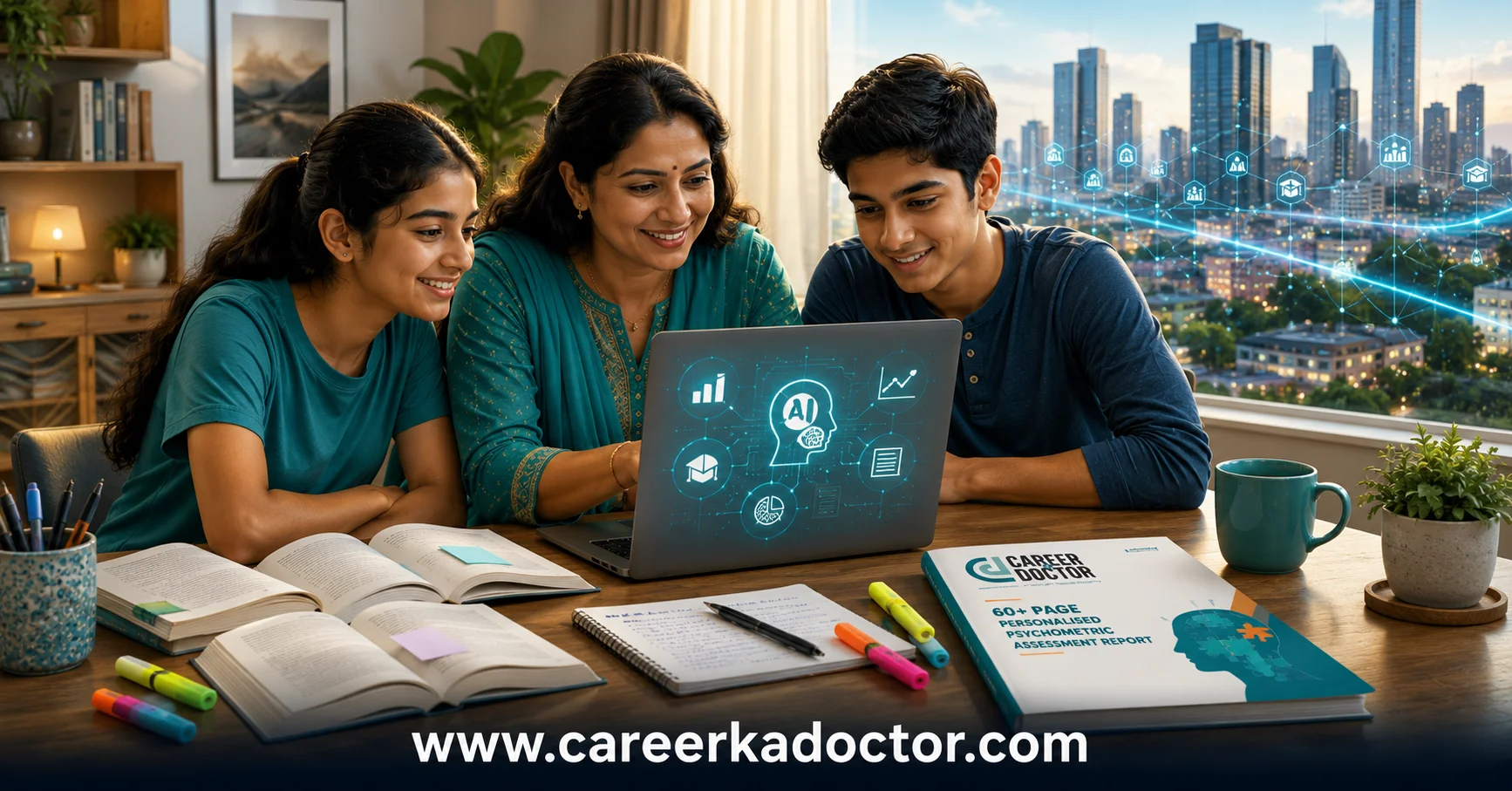
At Career Ka Doctor, founded by veteran counsellor Ameen e Mudassar, our detailed 60+ page personalized reports bridge the gap between human potential and industrial realities. We show you exactly how your child can step into the workforce with confidence, clarity, and a distinct human edge.
Take the First Step Today
Don’t leave your child’s stream selection to chance or outdated advice.