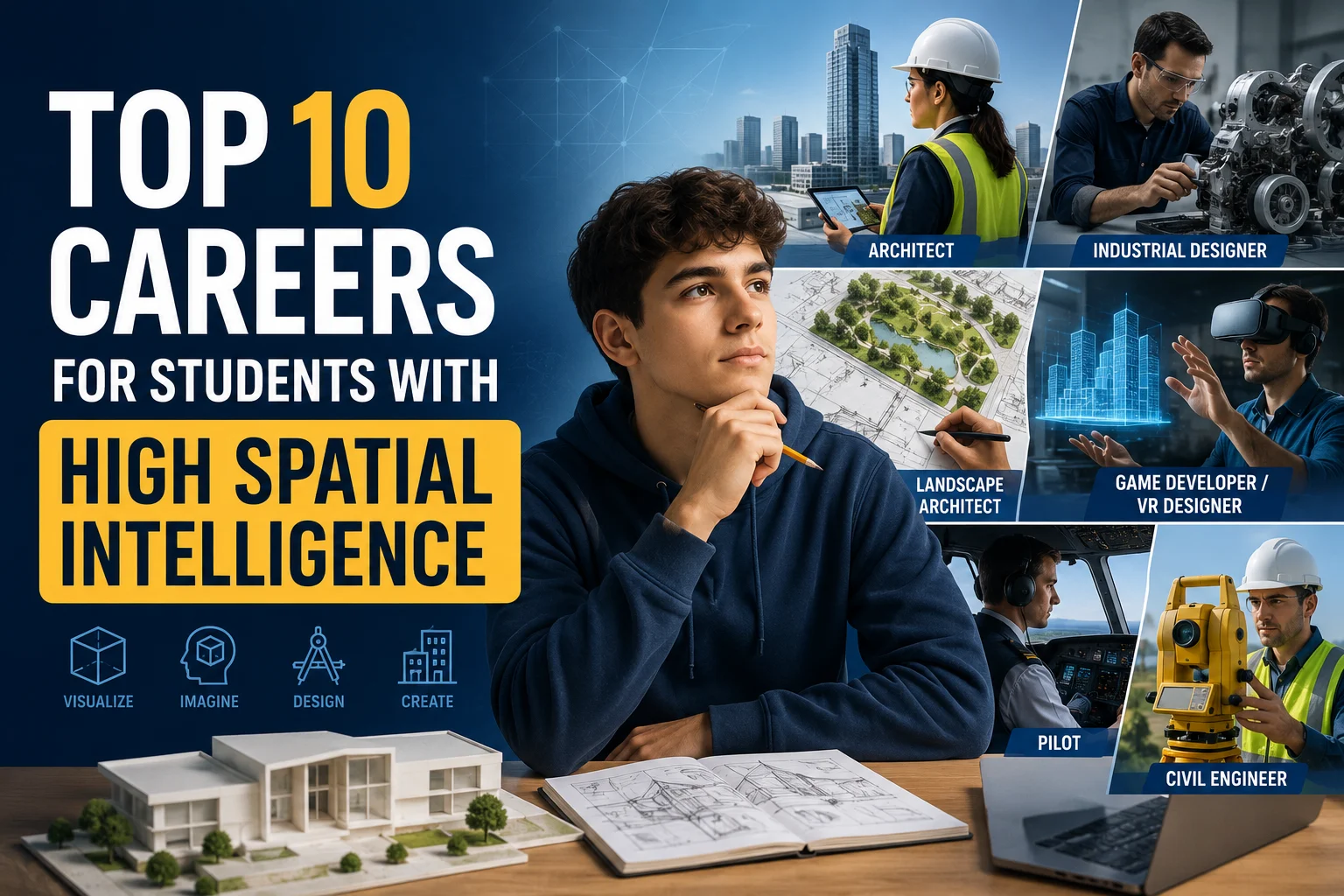
The top spatial intelligence careers for students in 2026 include architecture, civil engineering, surgery, industrial design, game design, urban planning, robotics engineering, interior design, orthodontics, and film direction/cinematography. Students who naturally excel at visualising 3D objects, reading maps, mentally rotating shapes, and understanding spatial relationships between objects hold a powerful aptitude advantage in these fields. Identifying spatial intelligence early — ideally between Classes IX and XII — allows students to choose the right stream, entrance exam, and college pathway with confidence rather than guesswork.
- Spatial intelligence is the ability to think in three dimensions — it underpins careers in architecture, design, engineering, surgery, and visual media.
- India offers robust educational pathways (JEE, NATA, NID entrance, NEET) that directly reward strong spatial reasoning ability.
- A spatial reasoning career typically involves creating, reading, or manipulating visual-spatial information — from blueprints and 3D models to surgical anatomy and robotic systems.
- Career Ka Doctor’s validated psychometric assessment measures spatial aptitude alongside six other aptitude types, helping students know — before choosing PCM, PCB, or Arts — where their natural strengths lie.
What Is Spatial Intelligence and Why Does It Matter for Career Choice?
Spatial intelligence — sometimes called spatial-visual intelligence — is the capacity to accurately perceive, manipulate, and reason about visual and spatial information. A student with high spatial intelligence can mentally rotate a 3D object, estimate distances intuitively, read complex diagrams with ease, and visualise how parts fit into a whole. In psychometric assessments, spatial aptitude is measured through tasks such as pattern recognition, block assembly, paper folding, and mental rotation of shapes.
For Indian students in Classes IX–XII, understanding spatial aptitude before stream selection is critical. A student strong in spatial reasoning who is pushed into Commerce purely for “safe job prospects” may struggle with motivation and underperform, while the same student might thrive in architecture design engineering careers India offers through institutions like IITs, NITs, SPA Delhi, NID Ahmedabad, or IIT IDC (now IIT Bombay’s Industrial Design Centre). Knowing your aptitude profile early transforms the stream-selection decision from a gamble into a data-backed strategy.
Top 10 Spatial Intelligence Careers for Indian Students in 2026
Below is a curated list of ten careers where spatial intelligence is the primary aptitude advantage. For each, we include the Indian educational pathway, typical entrance exams, and realistic salary expectations in 2026.
1. Architecture
Architects design buildings, campuses, and public spaces — a role that demands constant spatial visualisation. In India, the pathway is B.Arch (5 years) through NATA or JEE Main Paper 2. Top colleges include SPA Delhi, SPA Bhopal, IIT Kharagpur, and CEPT Ahmedabad. Starting salaries range from ₹4–7 LPA, rising steeply with experience and licensure. Architects use CAD, BIM (Revit), and SketchUp daily — all tools that reward spatial thinkers.
2. Civil and Structural Engineering
Civil engineers translate architectural designs into physically viable structures — bridges, highways, dams, and high-rises. Admission is through JEE Main/Advanced or state CETs after PCM in Class XI–XII. Spatial reasoning helps engineers read structural drawings, visualise load paths, and troubleshoot construction issues in real-time. Starting salaries at top firms and PSUs range from ₹5–10 LPA.
3. Industrial and Product Design
Industrial designers create everything from smartphones to furniture to medical devices. India’s premier pathway is B.Des at NID Ahmedabad, IIT IDC Mumbai, or NIFT. Entrance exams like NID DAT and UCEED specifically test spatial and visual reasoning. Graduates earn ₹6–12 LPA at firms like Titan, Godrej, or design consultancies, with freelance earnings often higher.
4. Surgery (General, Orthopaedic, Neuro)
Surgeons must mentally map 3D anatomy from 2D imaging (X-rays, MRIs, CT scans) and operate in tight, three-dimensional spaces. The pathway is MBBS via NEET UG followed by MS/MCh specialisation. While verbal and numerical aptitudes matter in medicine, surgical specialties specifically reward spatial intelligence. Surgeons in India earn ₹15–50+ LPA depending on specialisation and city.
5. Game Design and 3D Animation
India’s gaming industry is projected to exceed $10 billion by 2026. Game designers and 3D animators build immersive virtual worlds — a process that is pure spatial reasoning. Pathways include B.Des (Game Design) at MIT Pune, Srishti Manipal, or Whistling Woods, as well as industry-recognised diplomas from Arena Animation or MAAC. Starting salaries range from ₹4–8 LPA, with experienced professionals earning ₹15–25 LPA at studios like Ubisoft Pune or Rockstar India.
6. Urban Planning and Smart City Design
With India’s Smart Cities Mission and rapid urbanisation, urban planners are in high demand. They design city layouts, zoning plans, and transport networks — all spatially intensive tasks. B.Planning (4 years) is offered through JEE Main Paper 2, with top programs at SPA Delhi and IIT Kharagpur. Salaries in government and consultancy range from ₹5–12 LPA, and the field is growing fast.
7. Robotics and Mechatronics Engineering
Robotics engineers design, build, and program machines that move through 3D space. They must visualise mechanical assemblies, understand kinematics, and plan robot motion paths. B.Tech in Mechatronics or Robotics is available at VIT, Manipal, and several IITs. Entry-level salaries are ₹6–12 LPA, with top talent at companies like Addverb Technologies or Flux Auto earning significantly more.
8. Interior Design and Spatial Design
Interior designers transform spaces — homes, offices, hospitals, retail stores — by manipulating layouts, lighting, materials, and furniture placement. Pathways include B.Des (Interior Design) at NID, Pearl Academy, or JJ School of Art. This spatial reasoning career rewards people who can walk into an empty room and instantly visualise its potential. Starting salaries are ₹3–6 LPA, but experienced designers and entrepreneurs earn ₹15 LPA and above.
9. Orthodontics and Dental Surgery
Orthodontists work in the complex 3D space of the human jaw, planning tooth movements using digital scans and cephalometric analysis. The pathway is BDS (via NEET UG) followed by MDS in Orthodontics. Spatial intelligence is essential for treatment planning with aligners and braces. Private-practice orthodontists routinely earn ₹20–60+ LPA in metro cities.
10. Film Direction and Cinematography
Directors and cinematographers compose visual frames, plan camera movements through 3D space, and block actor positions across complex sets. India’s pathways include FTII Pune, Satyajit Ray Film Institute, and Whistling Woods. While creativity and storytelling matter enormously, the spatial component — framing, depth, perspective, lens selection — is what separates technically accomplished visual storytellers from the rest. Earnings vary widely but can reach ₹10–50+ LPA for established professionals.
How to Identify High Spatial Intelligence in Your Child
Many parents notice spatial ability without having a name for it. Does your child enjoy jigsaw puzzles, Lego construction, or Minecraft building? Do they naturally read maps, sketch 3D objects, or notice symmetry and patterns in everyday life? Do they excel at geometry but find rote memorisation tedious? These are strong indicators of spatial aptitude.
However, informal observation is not a substitute for validated measurement. A psychometric assessment specifically designed to measure spatial aptitude — along with abstract, numerical, verbal, operational, mechanical, and linguistic reasoning — gives families a precise, objective data point. This is especially important at the Class IX–X stage, when students in CBSE, ICSE, and State Board systems must choose between PCM, PCB, Commerce, and Arts streams. The wrong stream choice, driven by peer pressure or parental assumption, can cost a student years of struggle in a field misaligned with their natural strengths.
Education Pathways for Spatial Careers in India: Stream and Exam Planning
For most of the architecture design engineering careers India offers, the default stream is PCM (Physics, Chemistry, Mathematics) in Classes XI–XII. This opens the door to JEE Main, JEE Advanced, NATA, NID DAT, and UCEED. Students targeting surgery or orthodontics will take PCB and prepare for NEET UG. Those interested in film direction or animation may choose Arts or Commerce with a strong portfolio and entrance-exam preparation.
The critical mistake many families make is choosing the stream first and the career second. A better approach is to identify the student’s aptitude profile — including spatial intelligence — and then reverse-engineer the optimal stream, entrance exam, and college target. For example, a student with high spatial and high mechanical aptitude might be ideally suited for robotics engineering via JEE, while a student with high spatial and high verbal aptitude might thrive in architecture or urban planning. The combination of aptitudes matters as much as any single score.
Why Starting in Class IX–X Gives You an Advantage
Students who identify their spatial strengths in Class IX or X have two to three years to build relevant skills — learning CAD software, joining robotics clubs, building design portfolios, or taking advanced geometry electives. This preparation is not just personally fulfilling; it strengthens college applications, especially for design schools like NID and NIFT that value demonstrated spatial-visual ability in their entrance exams.
The Career Ka Doctor Approach to Career Guidance
Career Ka Doctor’s validated psychometric assessment measures all 7 aptitude types — including spatial intelligence — alongside 28 personality traits. The result is a personalised 60+ page report that doesn’t just label a student as “spatially strong” but shows exactly how spatial aptitude interacts with their other strengths and personality dimensions. The report provides 3 specific career recommendations ranked by natural fit using the proprietary Effort Index, which quantifies how much effort a student would need to succeed in each career relative to their innate aptitude profile.
Used by 23+ schools across India and the Middle East, the assessment is designed for students in Classes IX–XII — the exact window when stream selection, entrance exam planning, and career direction decisions must be made. Unlike generic interest inventories that ask students what they “like,” Career Ka Doctor measures what they are naturally good at, providing an objective foundation for one of the most consequential decisions in a young person’s life. Learn more about how the assessment works, understand the Effort Index and how it ranks career fit, or book a free consultation to discuss your child’s unique profile with a career counsellor.
Career Ka Doctor’s complete assessment — 60+ page report + expert counselling session —
gives you data, not guesswork. Book a free consultation on WhatsApp today:
Frequently Asked Questions
What are the best spatial intelligence careers for students in India in 2026?
The best spatial intelligence careers in India in 2026 include architecture, civil engineering, industrial design, surgery, game design, urban planning, robotics engineering, interior design, orthodontics, and cinematography. Each of these careers directly rewards the ability to think in three dimensions, visualise objects and spaces, and manipulate spatial information — skills that can be objectively measured through psychometric assessments.
How do I know if my child has high spatial intelligence?
Common signs include a strong interest in building (Lego, Minecraft, model kits), ease with geometry and diagrams, natural map-reading ability, and a habit of sketching or visualising ideas in 3D. However, the only reliable way to confirm high spatial aptitude is through a validated psychometric assessment that provides an objective score, not just subjective observation.
Which stream should a spatially intelligent student choose — PCM, PCB, or Arts?
It depends on the specific career target. PCM opens doors to architecture, engineering, robotics, and design (via JEE, NATA, NID DAT). PCB is necessary for surgery and orthodontics (via NEET). Arts can lead to film direction, animation, and fine arts. The stream choice should follow the career direction, not the other way around — and a spatial reasoning career assessment can clarify which path fits best.
Is spatial intelligence the same as being good at drawing?
No. Drawing is a learned motor skill, while spatial intelligence is a cognitive aptitude — the ability to mentally visualise, rotate, and manipulate objects in space. Many people with high spatial intelligence are not skilled artists, and vice versa. An architect, for example, relies more on spatial reasoning to read blueprints and plan 3D structures than on freehand drawing ability.
What entrance exams in India test spatial reasoning ability?
Several major entrance exams have components that test spatial reasoning. NATA (National Aptitude Test in Architecture) directly assesses spatial and drawing aptitude. NID DAT and UCEED test visual-spatial reasoning for design admissions. JEE Main Paper 2 (B.Arch/B.Planning) includes drawing and aptitude sections. Even NEET-based surgical training indirectly rewards spatial thinkers during clinical skill assessments.
Can spatial intelligence be improved, or is it fixed?
Research shows that spatial skills can be improved with targeted practice — activities like playing 3D puzzle games, learning CAD software, practicing mental rotation exercises, and engaging in hands-on building projects can all strengthen spatial reasoning. However, baseline spatial aptitude varies significantly between individuals, and a student with naturally high spatial intelligence will always have an advantage in spatially demanding careers compared to someone who must work much harder to develop the same skill level.