
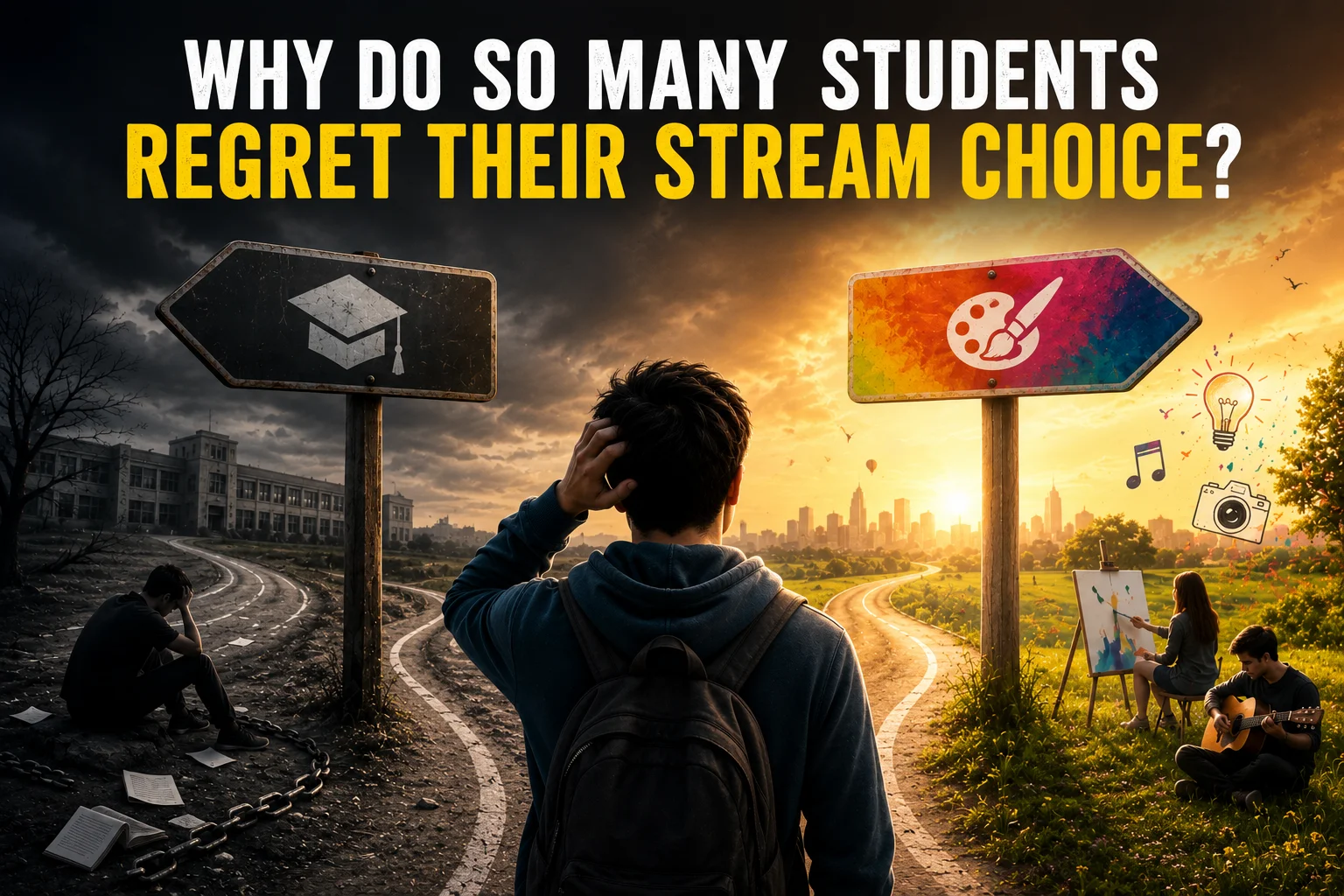
So many students regret their stream choice because the decision is overwhelmingly driven by parental pressure, peer influence, and cut-off marks — not by an understanding of the student’s actual aptitudes and personality. Research from psychometric assessments conducted across Indian schools shows that nearly 60% of students end up in streams misaligned with their natural strengths, making wrong stream choice India’s most expensive and emotionally damaging educational mistake. The good news: this is entirely preventable with the right data at the right time.
- Up to 60% of Indian students report stream regret class 11, often within the first 3–4 months of starting.
- A wrong stream choice costs families ₹2–10 lakhs in wasted coaching fees, lost years, and course corrections.
- The top 3 drivers of wrong choices are parental pressure, herd mentality (“Science is best”), and ignoring aptitude data.
- Changing stream after class 10 with proper psychometric guidance — before admission deadlines — can save years of frustration and money.
The Scale of Wrong Stream Choice in India: It’s Bigger Than You Think
Every April and May, roughly 1.5 crore Indian students face the same high-stakes decision after their Class X board exams: Science (PCM or PCB), Commerce, or Arts/Humanities. Most families treat this as a binary — “My child scored 90%, so Science is obvious.” But marks in Class X measure rote learning, not aptitude for a specific career path. A student who scores 95 in CBSE Maths may have achieved it through sheer drilling, yet possess strong verbal and linguistic aptitudes that would make them an exceptional lawyer, journalist, or policy analyst.
Data from validated psychometric assessments administered across 23+ schools in India and the Middle East reveals a startling pattern: approximately 6 out of 10 students tested show a primary aptitude profile that does not align with the stream they were planning to choose. This is the root of wrong stream choice India faces at a systemic level — a massive, silent misallocation of human potential driven by incomplete information.
What the Numbers Actually Look Like
Consider this breakdown from assessment data: among students who intended to take PCM (Physics, Chemistry, Maths), nearly 35% showed weak numerical and spatial aptitudes but strong verbal or operational strengths. Among students headed for Commerce, about 25% had high abstract and mechanical reasoning — profiles better suited for engineering or design. The mismatch isn’t random; it’s the predictable result of a system where stream selection is based on marks, not minds.
Stream Regret Class 11: When Reality Hits
The first term of Class XI is when stream regret class 11 typically surfaces. The leap from Class X to Class XI is enormous — the CBSE syllabus itself acknowledges this, with topics like Rotational Mechanics, Organic Chemistry, or Accountancy demanding fundamentally different cognitive skills than what Class X tested. A student who “chose” PCM because of family expectations suddenly finds themselves unable to visualise 3D geometry problems (low spatial aptitude) or struggling with the abstract reasoning required for Physics derivations.
The emotional toll is severe. School counsellors across metro and Tier-2 cities report a spike in anxiety, sleep disorders, and academic disengagement among Class XI students between August and November. Parents often misread this as “laziness” or “phone addiction,” but the underlying cause is frequently a fundamental mismatch between the student’s natural cognitive strengths and the demands of their chosen stream.
The Emotional Cost Nobody Talks About
Stream regret doesn’t just affect grades — it erodes a teenager’s self-concept. A student who was confident and curious in Class X can become withdrawn and self-doubting in Class XI, not because they lack intelligence, but because they’re being asked to perform in an arena that fights against their natural wiring. When a student with high linguistic and verbal aptitude is forced into PCM, every Physics test feels like running uphill in sand. The internal narrative shifts from “I’m smart” to “Something is wrong with me.” This psychological damage can persist well into college and early career years.
The Financial Cost of a Wrong Stream Decision
Let’s put real rupee figures on this. A typical PCM student in a metro city spends ₹1.5–3 lakhs per year on coaching (JEE/NEET preparation), plus school fees. If the student realises by Class XII that engineering or medicine isn’t for them, the family has spent ₹3–6 lakhs on coaching alone — money that delivered no career outcome. Many students then take a “drop year,” adding another ₹1.5–2 lakhs in coaching fees plus the opportunity cost of one full year.
In worse cases, students complete an entire B.Tech degree they never wanted, spending ₹4–15 lakhs on college fees, only to pivot to MBA, law, or design afterwards — effectively adding 2–5 extra years and ₹5–15 lakhs to their career journey. A Commerce student who should have been in Humanities may clear CA Foundation but fail CA Inter repeatedly, spending 3–4 additional years and ₹2–4 lakhs in coaching. All of this traces back to one poorly informed decision made at age 15.
Comparison: Cost of Prevention vs. Cost of Correction
A comprehensive psychometric assessment and expert counselling session costs a fraction of one month’s coaching fee. Yet most families will spend ₹50,000+ on JEE coaching registration without investing ₹5,000 in understanding whether their child is naturally suited for engineering in the first place. The return on investment for proper stream guidance isn’t incremental — it’s transformational. Prevention is not just cheaper than correction; it’s the difference between a child who thrives and one who merely survives.
Why Changing Stream After Class 10 Is Harder Than It Should Be
In theory, changing stream after class 10 should be straightforward — you haven’t committed to anything yet. In practice, Indian families face enormous social and logistical friction. Schools have limited seats in each stream and fill them based on Class X marks, not aptitude. A student who scored 88% may be “allowed” into Science by their school but actively discouraged from Commerce or Arts because the school (and parents) view those as lesser options.
The real barrier, however, is informational. Most families simply don’t have access to reliable data about their child’s aptitudes. They rely on three flawed proxies: board exam marks (which measure memory and practice, not aptitude), the child’s stated interest (which at 15 is heavily influenced by peers and media), and the advice of relatives (“My nephew did engineering and earns ₹20 LPA — your son should too”). None of these account for the seven distinct aptitude types or the 28 personality traits that actually predict career success and satisfaction.
The Window Is Small — Act Before It Closes
CBSE and ICSE schools typically finalise stream allotments by June. State board timelines vary, but most close by July. This means families have a 6–8 week window after Class X results to make (or change) this decision. If a student and family receive psychometric assessment data during Class IX or early Class X, they can approach this window with clarity rather than panic. Changing stream after class 10 becomes a confident, data-backed decision instead of a last-minute scramble.
Five Concrete Steps to Avoid a Wrong Stream Choice in 2026
If your child is in Class IX or X right now, here is exactly what you should do — not vague advice, but a specific action plan:
1. Get an Aptitude Assessment Before March 2026
Don’t wait for board results. A validated psychometric assessment should be taken in Class IX or early Class X, when there’s still time to process the results and explore options without deadline pressure. The assessment should measure multiple aptitude types (not just “logical” or “creative”) and personality dimensions.
2. Separate Marks from Aptitude in Family Discussions
Sit down as a family and explicitly acknowledge: “Scoring 92 in Maths does not mean our child should do engineering.” This one conversation can prevent years of misalignment. Ask your child not what career they want, but what kinds of tasks make them lose track of time — that’s a better indicator of natural aptitude.
3. Research Careers, Not Just Streams
Streams are vehicles; careers are destinations. A student interested in psychology needs PCM/PCB (for BSc Psychology at some universities) or Arts (for BA Psychology at others). A student aiming for UX Design could come from any stream. Map backwards from career to stream, not the other way around.
4. Talk to Professionals in Potential Career Fields
If your child’s assessment suggests aptitude for law, arrange a 15-minute call with a practicing advocate. If the data points to architecture, visit a firm. Real-world exposure corrects both over-romanticised and under-informed views of careers.
5. Build a Decision Matrix, Not a Decision by Committee
Create a simple table: aptitude fit, interest level, career growth potential, family feasibility. Score each stream option on these dimensions. This turns an emotional family debate into a structured evaluation — and the psychometric data gives you the most important column (aptitude fit) with scientific rigour.
The Career Ka Doctor Approach to Stream Selection
Career Ka Doctor was built precisely to solve the problem of wrong stream choice India faces every year. The approach begins with a validated psychometric assessment that measures 7 distinct aptitude types — Abstract, Numerical, Verbal, Operational, Mechanical, Linguistic, and Spatial — along with 28 personality traits that influence how a student works, learns, and makes decisions. This isn’t a 10-minute online quiz; it’s a rigorous, science-backed evaluation that produces a personalised 60+ page report for each student.
What makes the report genuinely useful is the Effort Index — a proprietary metric that ranks career options by how naturally they align with the student’s profile. A low Effort Index means the student’s aptitudes and personality are a natural fit for that career, meaning they’ll progress faster with less burnout. A high Effort Index flags careers where the student would need to constantly work against their grain. The report provides 3 specific career recommendations ranked by this index, giving families a clear, data-driven starting point for stream selection.
Currently used by 23+ schools across India and the Middle East, the Career Ka Doctor system pairs the assessment with an expert counselling session where a trained career counsellor walks the family through every page of the report, answers questions, and helps translate aptitude data into a concrete stream and subject combination. You can learn more about how the assessment works or book a free consultation to discuss whether this is the right step for your child.
Career Ka Doctor’s complete assessment — 60+ page report + expert counselling session —
gives you data, not guesswork. Book a free consultation on WhatsApp today:
Frequently Asked Questions
How common is wrong stream choice in India?
Extremely common. Psychometric assessment data from Indian schools indicates that approximately 60% of students select streams that don’t align with their strongest aptitudes. This happens because stream decisions are typically based on board exam marks and family expectations rather than validated aptitude data. The result is widespread underperformance and career dissatisfaction that could have been prevented.