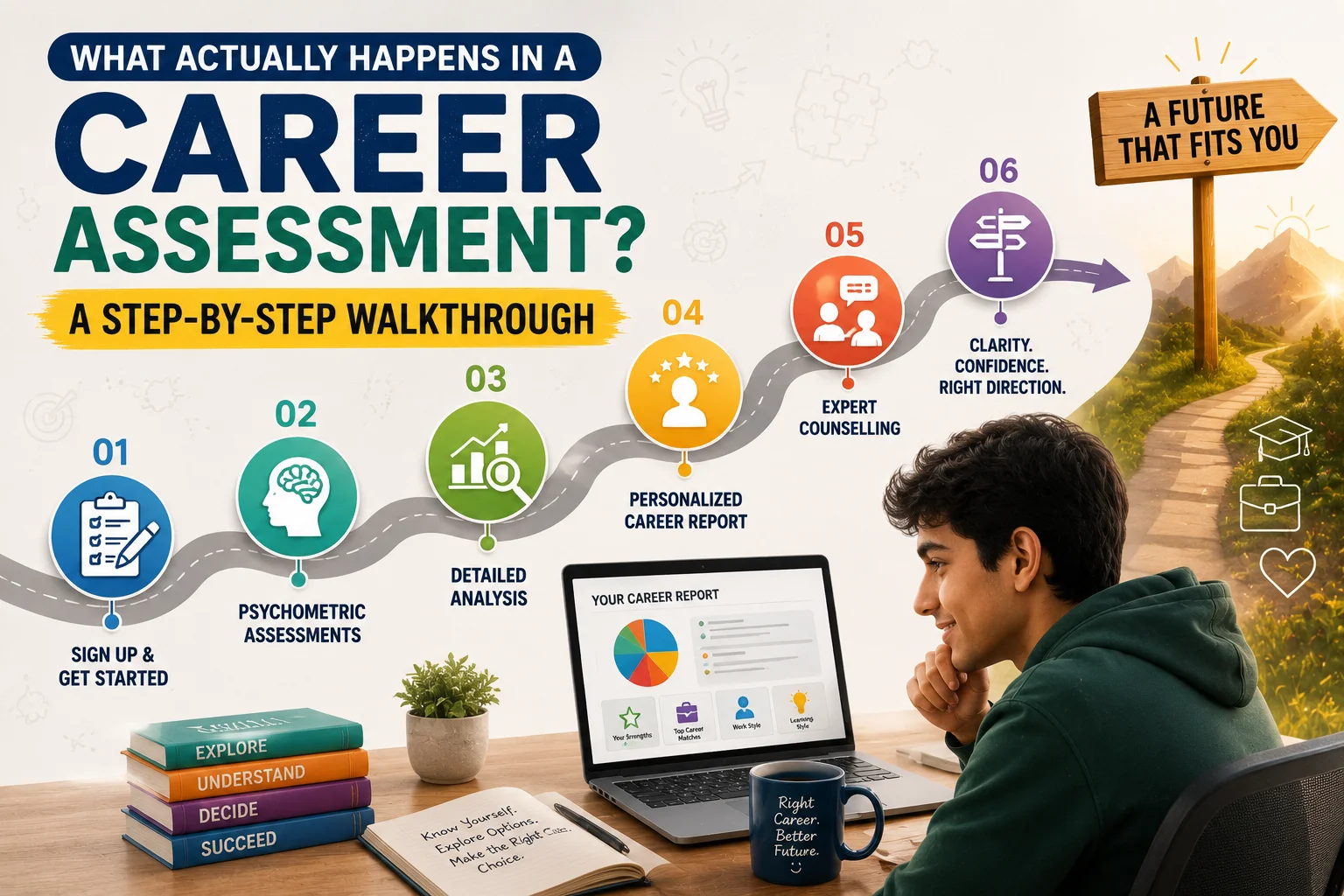
The career assessment India process at Career Ka Doctor involves four clear stages: booking a consultation, completing a validated psychometric assessment that measures 7 aptitude types and 28 personality traits, receiving a personalised 60+ page report with 3 career recommendations ranked by natural fit, and attending a one-on-one expert counselling session to build an actionable roadmap. The entire process — from booking to final counselling — typically takes 7 to 10 days and is designed specifically for students in Classes IX–XII studying under CBSE, ICSE, or State boards.
- The assessment has 4 distinct stages: booking → psychometric test → 60+ page report → expert counselling session
- The psychometric assessment measures 7 aptitude types (Abstract, Numerical, Verbal, Operational, Mechanical, Linguistic, Spatial) and 28 personality traits — it is not an interest quiz
- Each student receives 3 career recommendations ranked using the Effort Index, which quantifies how naturally suited they are to each career path
- The process is designed for Indian students in Classes IX–XII and directly addresses stream selection (PCM/PCB/Commerce/Arts), entrance exam planning (JEE/NEET/CA), and subject choices
Why Understanding the Career Assessment India Process Matters Before You Start
Most parents and students in India have never gone through a structured career assessment. The typical “career guidance” experience involves a school seminar where someone talks about engineering, medicine, and law for 45 minutes — or a well-meaning uncle who insists that your child should write JEE because they scored 87% in Class X Maths. Neither of these is a career assessment. Neither measures anything about the student.
A real career assessment is a structured, science-backed process that collects objective data about a student’s cognitive abilities, personality traits, and natural strengths — then translates that data into specific, ranked career recommendations. Understanding exactly what happens at each stage removes the mystery, builds trust, and helps families prepare properly. This guide walks you through every step of the psychometric assessment walkthrough at Career Ka Doctor, so you know exactly what to expect.
Stage 1: Booking and Initial Consultation
The career counselling process begins with a free consultation — typically over WhatsApp or a phone call. This is not a sales pitch; it is a 10–15 minute conversation where a counsellor understands the student’s current situation. Are they in Class IX trying to choose between PCM and PCB? Are they in Class XI already locked into Commerce but feeling uncertain? Are they in Class XII preparing for NEET but wondering if medicine is actually right for them?
During this initial conversation, the counsellor explains what the assessment measures, how long it takes, and what the report will contain. Parents often have specific questions: “Will this tell my child whether to take JEE or NEET?” or “My daughter wants to study design but we’re not sure if she has the aptitude.” These questions are addressed upfront. Once the family decides to proceed, the assessment is scheduled at a convenient time.
What You Need Before the Assessment
The student needs a quiet environment, a stable internet connection, and approximately 60 to 90 minutes of uninterrupted time. There is no preparation required — no syllabus to study, no formulas to memorise. The assessment is designed to measure natural cognitive abilities and inherent personality traits, not learned knowledge. A student who has studied under CBSE and another who has studied under ICSE will be assessed on equal footing because the test is curriculum-independent.
Stage 2: The Psychometric Assessment — What Actually Happens During the Test
This is the core of the career assessment India process and the stage that generates the most curiosity. The validated psychometric assessment used by Career Ka Doctor measures two distinct dimensions: aptitudes and personality.
The 7 Aptitude Tests
Aptitude is your natural ability to perform certain types of cognitive tasks — it is different from knowledge or skill. The assessment measures seven specific aptitude types:
Abstract Reasoning tests the ability to identify patterns and logical relationships without words or numbers — critical for careers in research, data science, and strategic consulting. Numerical Reasoning measures how naturally a student processes quantitative information — relevant for careers in finance, actuarial science, engineering, and CA. Verbal Reasoning assesses the ability to understand and analyse written information — essential for law, journalism, management, and civil services. Operational Reasoning tests systematic, process-oriented thinking — important for operations management, logistics, and project management. Mechanical Reasoning measures understanding of physical principles and how things work — relevant for engineering, architecture, and technical fields. Linguistic Ability evaluates language processing and communication aptitude — key for careers in content, communications, teaching, and diplomacy. Spatial Reasoning assesses the ability to visualise and manipulate objects mentally — crucial for design, architecture, surgery, and animation.
Each aptitude test is timed and presents the student with a series of problems that increase in difficulty. The student is not expected to complete every question — the test is designed to find the ceiling of natural ability. A student who scores in the 85th percentile on Spatial Reasoning and the 40th percentile on Numerical Reasoning has a very different aptitude profile from one with the reverse — and the career recommendations will reflect that difference precisely.
The 28 Personality Traits
The second part of the assessment measures 28 personality traits across dimensions such as leadership orientation, risk tolerance, independence, attention to detail, empathy, assertiveness, creativity, and resilience. These are measured through carefully designed questions with no “right” or “wrong” answers. The personality profile determines not just which careers a student can do, but which careers they will enjoy and sustain over a lifetime. A student with high empathy and patience has a fundamentally different career trajectory than one with high assertiveness and risk tolerance — even if their aptitude scores are identical.
Stage 3: The 60+ Page Personalised Report — What It Contains
Within a few days of completing the assessment, the family receives a comprehensive report that typically runs over 60 pages. This is not a generic PDF with vague advice. Every page is specific to the individual student. Here is what the report includes:
Aptitude Profile with Percentile Scores
Each of the 7 aptitudes is reported as a percentile score with a detailed explanation. For example, a student might see: “Your Abstract Reasoning score places you in the 78th percentile, meaning you outperformed 78% of students in your age group. This indicates a strong natural ability to identify complex patterns — a trait associated with success in fields such as data analytics, research science, and algorithmic problem-solving.” The report does not just give a number; it explains what the number means in the context of real careers in India.
Personality Trait Analysis
All 28 traits are mapped and explained. The report highlights the student’s dominant traits and explains how they influence career satisfaction. For instance, a student with high creativity and low conformity might struggle in a rigid, hierarchical work environment — the report will flag this and recommend career paths that offer autonomy and creative freedom.
3 Career Recommendations Ranked by the Effort Index
This is the most actionable section of the report. Based on the combined aptitude and personality data, the report identifies 3 specific career paths — not broad fields like “science” or “commerce,” but specific careers like “UX Design,” “Environmental Engineering,” or “Chartered Financial Analyst.” Each recommendation is ranked using the Effort Index, which quantifies how much effort the student would need to invest to succeed in that career relative to their natural strengths. A lower Effort Index means higher natural alignment — the student’s innate abilities and personality already match the career’s demands. A higher Effort Index means the student can still succeed but will need to work harder against their natural grain.
Stream and Subject Recommendations
For students in Class IX or X who haven’t yet chosen their stream, the report includes specific guidance: should they take PCM, PCB, Commerce with Maths, Commerce without Maths, or Arts/Humanities? For students already in Class XI or XII, the report validates or challenges their current stream choice and suggests course corrections if needed — such as specific elective subjects, competitive exams to target, or undergraduate programmes to prioritise.
Stage 4: The One-on-One Expert Counselling Session
The report is powerful on its own, but the career counselling process is completed through a one-on-one session with a trained career counsellor. This session typically lasts 45 to 60 minutes and involves both the student and the parent. The counsellor walks through every section of the report, answers questions, and helps the family build a concrete action plan.
This is where the real conversations happen. A father might ask, “My son’s top recommendation is Industrial Design, but I don’t know anyone in that field — what does the career path look like in India?” The counsellor provides specific information: typical undergraduate programmes (such as B.Des at IIT Bombay or NID Ahmedabad), expected starting salaries (₹5–8 lakhs per annum in 2026), growth trajectory, and companies that hire in that field. A mother might say, “My daughter’s report recommends Biotechnology, but she’s currently preparing for NEET — should she continue?” The counsellor uses the Effort Index data to give an honest, data-backed answer.
Building the Roadmap
By the end of the session, the family leaves with more than just career names. They have a clear roadmap: which entrance exams to focus on, which colleges to target, which skills to develop during the remaining school years, and which experiences (internships, online courses, projects) will strengthen the student’s application and readiness. For a Class IX student, this roadmap spans 3–4 years. For a Class XII student, it focuses on the next 6–12 months of critical decisions.
The Career Ka Doctor Approach to Career Guidance
Career Ka Doctor’s entire career assessment India process is built on one principle: career decisions should be based on data, not assumptions. The validated psychometric assessment measures 7 aptitude types and 28 personality traits — generating a comprehensive profile that is unique to each student. The 60+ page personalised report translates this data into 3 specific career recommendations ranked by the Effort Index, a proprietary metric that tells families exactly how naturally aligned a student is with each recommended career.
This approach is trusted by 23+ schools across India and the Middle East, serving students across CBSE, ICSE, and international curricula. The process is designed to be accessible and transparent — every score is explained, every recommendation is justified, and every family gets a one-on-one counselling session to ask questions and build a plan. You can learn more about how the assessment works, understand the Effort Index in detail, or book a free consultation to see if this is the right fit for your child.
Career Ka Doctor’s complete assessment — 60+ page report + expert counselling session —
gives you data, not guesswork. Book a free consultation on WhatsApp today:
 Book Free Consultation on WhatsApp →
Frequently Asked Questions
What is the career assessment India process at Career Ka Doctor?
The process has four stages: a free initial consultation, a validated psychometric assessment measuring 7 aptitudes and 28 personality traits, delivery of a personalised 60+ page report with 3 career recommendations ranked by the Effort Index, and a one-on-one expert counselling session. The entire process takes 7 to 10 days from booking to final session.
How long does the psychometric assessment take to complete?
The assessment takes approximately 60 to 90 minutes only