
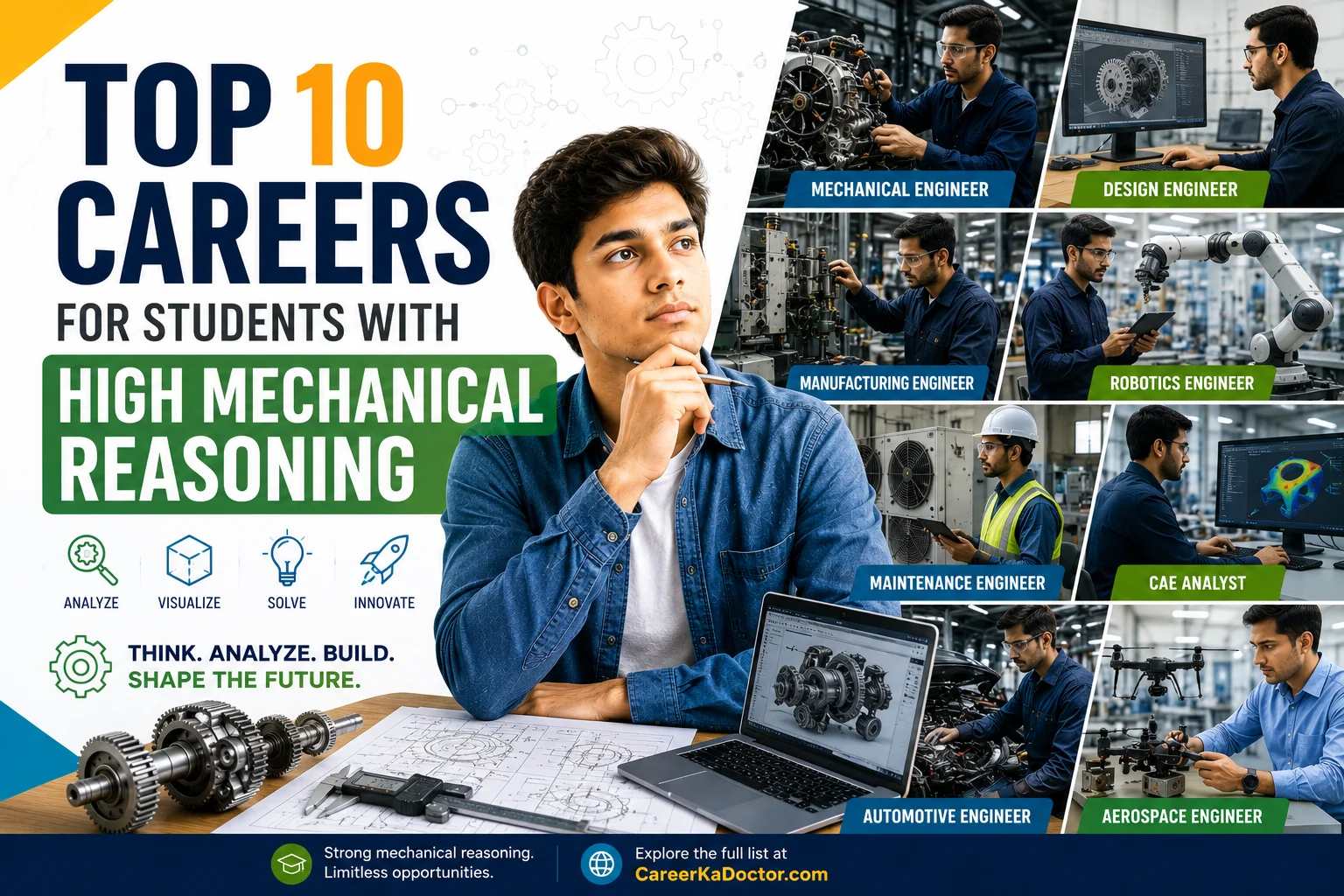
Students with high mechanical reasoning excel in careers that demand understanding of physical forces, machines, tools, and how components fit together — making mechanical aptitude careers such as mechanical engineering, robotics, automotive design, and industrial automation among the most rewarding and in-demand paths in India for 2026. These careers reward the ability to visualise how systems work, diagnose faults intuitively, and design solutions that function in the real world — a skill set that cannot be faked or memorised.
- Mechanical reasoning is a distinct aptitude — it measures how naturally you understand gears, levers, pulleys, forces, and spatial-mechanical relationships, not just your marks in Physics.
- India’s manufacturing, defence, EV, and robotics sectors are projected to create over 3 million new engineering technical careers by 2027, making high mechanical aptitude a genuine economic advantage.
- 10 specific careers — from aerospace engineering to prosthetics design — offer the strongest natural fit for students scoring high in this aptitude.
- Choosing a mechanical aptitude career aligned to your psychometric profile reduces the “Effort Index,” meaning you achieve more with less struggle compared to a mismatched career.
What Is Mechanical Reasoning — and Why Does It Matter for Mechanical Aptitude Careers?
Mechanical reasoning is the cognitive ability to understand how physical systems operate. It covers an intuitive grasp of concepts like force, torque, pressure, velocity, mechanical advantage, fluid dynamics, and how interconnected parts move together. A student with strong mechanical reasoning can look at a diagram of interlocking gears and immediately predict which direction the last gear turns — without doing a single calculation on paper.
This aptitude is one of the 7 aptitude dimensions measured in validated psychometric assessments, alongside abstract, numerical, verbal, operational, linguistic, and spatial reasoning. While spatial aptitude helps you visualise 3D shapes and mechanical aptitude is related, they are not the same. Mechanical reasoning specifically addresses cause-and-effect in physical systems: “If I push here, what happens there?” Students who score high in this area often enjoy taking things apart, tinkering with motors, building models, or understanding how engines work — even before they formally study Physics in Class XI.
Mechanical Reasoning vs. Scoring Well in Physics
Many parents assume that good marks in Physics automatically mean high mechanical aptitude. That is not always true. A student can memorise formulae and score 95 in board exams without having an intuitive feel for how machines behave. Conversely, a student who scores modestly in theory exams might have exceptional mechanical intuition — the kind that makes them a gifted diagnostician on a factory floor or a natural at designing mechanical systems. A psychometric assessment separates learned knowledge from innate aptitude, giving you a far more reliable basis for career decisions.
Top 10 Mechanical Aptitude Careers for Indian Students in 2026
Below are ten careers where high mechanical reasoning is the core advantage. For each, we mention the typical education pathway relevant to Indian students choosing between PCM, PCB, or other streams after Class X.
1. Mechanical Engineer
The most direct mechanical reasoning career in India. Mechanical engineers design, analyse, and manufacture everything from industrial machinery to consumer products. Entry typically requires a B.Tech/B.E. in Mechanical Engineering via JEE Main/Advanced, state CETs, or BITSAT. Starting salaries in India range from ₹4–8 LPA in core manufacturing firms, with experienced professionals in automotive or oil-and-gas sectors earning ₹15–30 LPA.
2. Robotics and Automation Engineer
India’s push toward Industry 4.0 and smart manufacturing means robotics engineers are in acute demand. This role blends mechanical aptitude with electronics and programming. Students typically pursue B.Tech in Mechatronics, Robotics, or Mechanical Engineering, often adding specialised certifications in ROS (Robot Operating System) or PLC programming. Companies like Tata Advanced Systems, Wipro Infrastructure, and numerous EV startups actively recruit for this role.
3. Aerospace Engineer
From ISRO to HAL to private players like Skyroot Aerospace and Agnikul Cosmos, India’s aerospace sector is booming. Aerospace engineers apply mechanical reasoning to design aircraft structures, propulsion systems, and satellite mechanisms. Entry is through B.Tech in Aerospace Engineering (IIT Bombay, IIT Madras, IIST Thiruvananthapuram) or Mechanical Engineering with an aerospace specialisation at the M.Tech level.
4. Automotive Design Engineer
With India becoming the world’s third-largest automobile market and the EV transition accelerating, automotive design engineers who understand powertrains, suspension systems, and vehicle dynamics are critically needed. Maruti Suzuki, Tata Motors, Mahindra, and Ola Electric all have large R&D centres in India. Students typically take the PCM stream, pursue B.Tech in Mechanical or Automotive Engineering, and may add NID or IISc-level design courses.
5. HVAC and Building Services Engineer
Heating, ventilation, and air conditioning (HVAC) is a ₹30,000-crore industry in India, growing at 10–12% annually. HVAC engineers design climate-control systems for hospitals, data centres, malls, and smart buildings. This is a deeply mechanical role involving thermodynamics, fluid mechanics, and ductwork design. A B.Tech in Mechanical Engineering followed by ASHRAE or ISHRAE certification is the standard pathway.
6. Industrial and Manufacturing Engineer
Manufacturing engineers optimise production lines, select tooling, design jigs and fixtures, and ensure quality. With the government’s Production-Linked Incentive (PLI) schemes drawing semiconductor and electronics manufacturing to India, this is among the fastest-growing engineering technical careers. B.Tech in Mechanical, Industrial, or Production Engineering is the entry route, with starting salaries of ₹5–9 LPA in companies like Foxconn India, Bosch, and L&T.
7. Marine Engineer
Marine engineers maintain and operate the mechanical systems aboard ships — engines, propulsion, hydraulic systems, and auxiliary machinery. India’s merchant navy offers tax-free salaries that can reach ₹15–25 LPA within five years. Entry is through a B.Tech in Marine Engineering from institutes like IMU (Indian Maritime University) or MERI (Marine Engineering and Research Institute), requiring PCM in Class XII.
8. Tool and Die Maker / CNC Programming Specialist
Often overlooked by parents focused on traditional engineering degrees, tool-and-die making is a high-skill, high-demand mechanical aptitude career. Skilled CNC programmers and tool designers earn ₹6–15 LPA and are in short supply across India’s auto-component and precision-manufacturing clusters in Pune, Chennai, Gurugram, and Coimbatore. Diploma in Tool and Die Making (e.g., from NTTF or Indo-German Tool Rooms) followed by industry experience is a proven pathway.
9. Biomedical Equipment Technician / Prosthetics Designer
This emerging field sits at the intersection of mechanical reasoning and healthcare. Biomedical equipment technicians service MRI machines, ventilators, and surgical robots, while prosthetics designers create artificial limbs using mechanical principles and 3D printing. Students can pursue B.Tech in Biomedical Engineering or a diploma followed by specialised training. The Indian medical devices market is projected to reach $50 billion by 2030, fuelling strong demand.
10. Defence Technology Engineer (DRDO / Ordnance Factories / Private Defence)
India’s defence manufacturing ecosystem — spanning DRDO labs, ordnance factories, and private firms like Bharat Forge, Kalyani Group, and Adani Defence — needs engineers who deeply understand ballistics, armour systems, weapon mechanisms, and military vehicle design. These are quintessential mechanical reasoning career India opportunities. Entry is typically via GATE-qualified M.Tech recruitment into DRDO, or B.Tech hiring by private defence companies.
How to Know If Your Child Has High Mechanical Reasoning
Behavioural signs often appear early: the child who disassembles the mixer grinder to see how it works, enjoys building complex LEGO Technic models, gravitates toward Physics experiments, or instinctively understands why a see-saw balances. However, behavioural observation alone is unreliable. Many students with strong mechanical aptitude mask it because their school curriculum — especially CBSE and ICSE — does not explicitly test this skill. Board exams assess theoretical knowledge, not the hands-on intuition that distinguishes a great mechanical engineer from an average one.
A validated psychometric assessment provides an objective measurement. It uses standardised tasks — such as gear-train problems, lever-and-pulley scenarios, and force-direction questions — to quantify mechanical reasoning relative to a normed population. This score, combined with 6 other aptitude scores and 28 personality traits, creates a multi-dimensional profile that reveals which of the mechanical aptitude careers listed above would be the most natural and least effortful fit for your child.
Educational Pathways: From Class IX to Mechanical Aptitude Careers
If your child is in Class IX or X, stream selection is the first critical decision. Almost all mechanical aptitude careers require the PCM (Physics, Chemistry, Mathematics) stream in Classes XI–XII. A few — like biomedical equipment technology — can also be approached from PCB with additional engineering coursework, but PCM keeps the widest range of doors open.
After Class XII, the primary routes are:
- B.Tech/B.E. (4 years): Through JEE Main, JEE Advanced, state CETs (MHT-CET, KCET, WBJEE, etc.), or university-specific exams. Target branches: Mechanical, Mechatronics, Aerospace, Automotive, Marine, Industrial, or Biomedical Engineering.
- Diploma (3 years after Class X): Polytechnic diplomas in Mechanical Engineering or Tool and Die Making offer a faster route into hands-on roles, with the option to do a lateral-entry B.Tech later.
- Integrated M.Tech/M.S. (5 years): Offered by IITs and IISc for students who clear JEE Advanced, combining undergraduate and postgraduate training.
- Specialised institutes: NTTF, Indo-German Tool Rooms, Central Institute of Tool Design (CITD), Indian Maritime University, IIST Thiruvananthapuram.
The key is to align the educational pathway not just to the career label but to the student’s aptitude profile. A student with high mechanical reasoning but low numerical aptitude, for example, may thrive in hands-on roles like CNC programming but struggle in research-heavy aerospace engineering. This is precisely where a personalised assessment prevents costly mismatches.
Salary and Growth Outlook for Engineering Technical Careers in India (2026)
India’s manufacturing sector GDP contribution is targeted to reach 25% by 2030 under the Make in India initiative. Combined with PLI schemes across 14 sectors — including automotive, drones, semiconductors, and defence — the demand for professionals in engineering technical careers is at an all-time high. Here is a realistic salary snapshot for 2026:
- Mechanical Engineer (core manufacturing): ₹4.5–8 LPA (entry), ₹12–25 LPA (mid-career)
- Robotics / Automation Engineer: ₹6–10 LPA (entry), ₹15–35 LPA (mid-career)
- Aerospace Engineer: ₹6–12 LPA (entry), ₹18–40 LPA (mid-career)
- Automotive Design Engineer: ₹5–9 LPA (entry), ₹14–30 LPA (mid-career)
- Marine Engineer: ₹8–15 LPA (entry, tax-free onboard), ₹20–35 LPA (mid-career)
- Defence Technology Engineer: ₹6–11 LPA (entry), ₹15–30 LPA (mid-career)
- CNC/Tool & Die Specialist: ₹3.5–6 LPA (entry), ₹10–18 LPA (experienced)
These numbers vary significantly by company, location, and individual skill level. The consistent finding, however, is that professionals whose natural aptitude matches their work tend to progress faster — they get promoted sooner, earn more, and report higher job satisfaction. This is the principle behind the Effort Index used in modern career assessments.
The Career Ka Doctor Approach to Career Guidance
Career Ka Doctor uses a validated psychometric assessment that measures 7 distinct aptitude types — including mechanical reasoning — alongside 28 personality traits. The result is a personalised 60+ page report that does not simply list careers but ranks 3 specific career recommendations by natural fit using the Effort Index. The Effort Index quantifies how much cognitive and emotional effort a student would need to succeed in a given career: the lower the index, the more natural the fit. For a student with high mechanical reasoning, the report might rank Robotics Engineering as a low-effort (high-fit) career and, say, corporate law as a high-effort (poor-fit) career — giving families a clear, data-driven basis for decision-making.
The assessment is currently used by 23+ schools across India and the Middle East, and is suitable for students from Class IX onwards — early enough to influence stream selection and exam preparation strategy. To understand the complete process, visit how the assessment works. If you would like to discuss your child’s specific situation with a career counsellor, you can book a free consultation — there is no obligation, and the conversation alone often brings clarity that months of guesswork cannot.
Career Ka Doctor’s complete assessment — 60+ page report + expert counselling session —
gives you data, not guesswork. Book a free consultation on WhatsApp today:
Frequently Asked Questions
What are the best mechanical aptitude careers for PCM students in India?
The strongest mechanical aptitude careers for PCM students include mechanical engineering, robotics and automation engineering, aerospace engineering, automotive design, marine engineering, and defence technology engineering. All of these require Physics and Mathematics at the Class XII level and are accessible through JEE, state-level engineering entrance exams, or specialised institutes like IIST and IMU.
How is mechanical reasoning different from spatial aptitude?
Spatial aptitude measures the ability to mentally rotate, fold, and manipulate shapes in three dimensions. Mechanical reasoning goes further — it measures understanding of physical cause-and-effect: how gears mesh, how forces transmit through levers, and how fluid pressure works in hydraulic systems. A student can have high spatial ability but average mechanical reasoning, or vice versa. Both are measured independently in a comprehensive psychometric assessment.