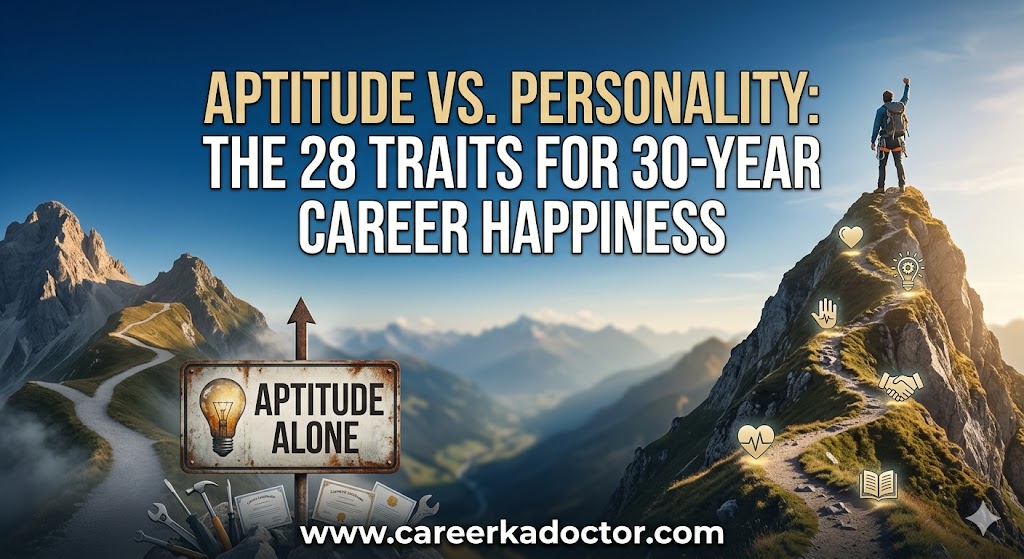
Aptitude tells you what a student can do; personality traits decide what they will enjoy doing for 30+ years. Two students with identical numerical and abstract aptitudes can end up miserable or thriving in completely different careers because their 28 personality traits career match differs — one may love solitary research while the other craves team leadership. Understanding personality traits career choice India is the missing piece that explains why toppers sometimes abandon lucrative careers within five years, and why “average” students sometimes build extraordinary professional lives.
- Aptitude measures ability, but 28 personality traits determine whether a student will sustain motivation, satisfaction, and growth over a 30-year career.
- HIGH, MEDIUM, and LOW scores on each trait are neither good nor bad — they simply predict fit for specific career environments.
- Two students scoring equally high in Numerical aptitude may diverge into actuarial science vs. financial journalism based on traits like Risk Appetite, Sociability, and Need for Structure.
- Career satisfaction personality India research shows that trait-career mismatches are a leading cause of mid-career switches, costing families lakhs in wasted education investment.
Why Personality Traits Career Choice India Matters More Than Marks
Every year, millions of Indian students choose between PCM, PCB, Commerce, and Arts streams based on one metric: exam scores. A student scoring 95% in Science is funnelled into PCM and pointed toward JEE or NEET. A student scoring well in Accounts is told to pursue CA. The assumption is simple — if you’re good at something, you should do it for a living. But this logic ignores a critical question: will you want to do it every day for the next three decades?
Consider two Class X students in a CBSE school in Bengaluru. Both score identically on a validated psychometric assessment: high Numerical aptitude, high Abstract reasoning, moderate Verbal ability. Traditional career advice would put them on the same track — engineering, data science, or quantitative finance. But their personality profiles tell a radically different story. Student A scores HIGH on Independence, LOW on Sociability, and HIGH on Persistence. Student B scores HIGH on Sociability, HIGH on Risk Appetite, and LOW on Need for Structure. Student A would thrive as a research mathematician or backend engineer. Student B would flourish as a startup founder or management consultant. Same aptitude. Completely different ideal careers. This is precisely why understanding 28 personality traits career mapping is non-negotiable for making informed career decisions.
The 28 Personality Traits That Shape Long-Term Career Satisfaction
Career Ka Doctor’s validated psychometric assessment measures 28 distinct personality traits, each scored as HIGH, MEDIUM, or LOW. These are not labels — they are data points that, when combined with aptitude scores, predict where a student will experience the least friction and the most natural motivation over a long career. Let us break down these traits across functional clusters so you can see how they work in real career contexts.
Drive and Motivation Traits
Achievement Orientation, Persistence, Ambition, Initiative, and Work Drive — these five traits determine how a student responds to long-term challenges. A student with HIGH Persistence and HIGH Achievement Orientation is naturally suited for careers requiring years of deferred gratification: UPSC preparation, surgical specialisation, or PhD research. A student with LOW Persistence but HIGH Initiative may thrive in fast-paced environments like digital marketing, event management, or entrepreneurship, where results come quickly and variety is constant. Neither profile is better; they simply belong in different career ecosystems.
Social and Interpersonal Traits
Sociability, Empathy, Assertiveness, Leadership Potential, Team Orientation, Influence, and Trust — these seven traits predict whether someone will be energised or drained by constant human interaction. A PCB student preparing for NEET with HIGH Empathy, HIGH Sociability, and HIGH Leadership Potential is an excellent fit for clinical medicine or public health leadership. The same aptitude profile with LOW Sociability and HIGH Independence points toward pathology, radiology, or biomedical research. In India, we rarely make this distinction — we simply say “become a doctor” without specifying which kind of doctor suits the person.
Emotional and Stress-Response Traits
Emotional Stability, Stress Tolerance, Self-Confidence, Optimism, and Adaptability — these five traits predict how a student handles the daily emotional demands of a career. Careers in emergency medicine, criminal law, journalism, or stock trading require HIGH Stress Tolerance and HIGH Emotional Stability. A student with LOW Stress Tolerance isn’t weak — they simply need a career environment with more predictability, such as academic research, library science, or quality assurance. Ignoring these traits is why so many Indian professionals report burnout within 5–7 years of entering high-pressure fields.
Cognitive Style Traits
Creativity, Analytical Thinking, Attention to Detail, Need for Structure, and Openness to Experience — these five traits determine how a student prefers to process information and solve problems. A Commerce student with HIGH Analytical Thinking and HIGH Need for Structure is a natural fit for chartered accountancy or auditing. The same Commerce student with HIGH Creativity and HIGH Openness to Experience would be miserable in audit but could excel in advertising strategy, brand consulting, or financial product design. Career satisfaction personality India data consistently shows that cognitive style mismatches cause the most intense day-to-day dissatisfaction because they affect every single working hour.
Values and Orientation Traits
Independence, Risk Appetite, Responsibility, Ethical Orientation, Service Orientation, and Status Orientation — these six traits reflect what a student fundamentally values in their professional life. A student with HIGH Independence and HIGH Risk Appetite will feel suffocated in a large corporate hierarchy, regardless of salary. A student with HIGH Service Orientation and HIGH Ethical Orientation will find deep meaning in NGO work, teaching, or public policy — careers that Indian parents often discourage due to perceived low income. Understanding these value-based traits prevents the tragically common scenario where a student pursues a “safe” career for 10 years before quitting to follow their actual calling.
How HIGH, MEDIUM, and LOW Scores Actually Predict Career Fit
Parents often ask: “Is a HIGH score better than a LOW score?” The answer is unequivocally no. Each score is a compass direction, not a ranking. A HIGH score on Sociability is a disadvantage in careers requiring deep solo concentration (research science, software architecture, forensic accounting). A LOW score on Risk Appetite is a genuine strength in careers demanding meticulous caution (air traffic control, pharmaceutical testing, civil engineering). The key is alignment — matching the trait profile to the career environment.
MEDIUM scores are particularly interesting because they indicate flexibility. A student with MEDIUM Leadership Potential can function in both team-leader and individual-contributor roles, giving them a wider range of suitable careers. During counselling, MEDIUM scores allow Career Ka Doctor’s experts to weigh other traits and aptitudes more heavily, creating a nuanced recommendation rather than a rigid one. This is why a 60+ page personalised report is necessary — a one-page summary simply cannot capture the interplay of 7 aptitudes and 28 personality traits across hundreds of possible career paths.
Real-World Examples: Same Aptitude, Different Personality, Different Career
Let us walk through three scenarios that Indian families encounter every year during stream selection in Class IX–X.
Scenario 1: Two High-Numerical Students
Riya and Arjun both score in the 90th percentile on Numerical aptitude. Riya has HIGH Attention to Detail, HIGH Need for Structure, LOW Risk Appetite, and HIGH Persistence. Arjun has HIGH Risk Appetite, HIGH Sociability, LOW Need for Structure, and HIGH Influence. Riya’s ideal careers: actuarial science, data quality analysis, or forensic accounting. Arjun’s ideal careers: investment banking, venture capital, or fintech entrepreneurship. If Riya is pushed into a client-facing finance role, she will burn out. If Arjun is placed in a back-office analytical role, he will disengage within months.
Scenario 2: Two High-Verbal, High-Empathy Students
Meera and Kavya both have strong Verbal aptitude and HIGH Empathy. But Meera also has HIGH Assertiveness and HIGH Stress Tolerance, while Kavya has LOW Assertiveness and HIGH Creativity. Meera is a natural fit for litigation, crisis communication, or broadcast journalism. Kavya would thrive in creative writing, counselling psychology, or content strategy. The aptitude report alone would have recommended identical careers for both.
Scenario 3: The “All-Rounder” Trap
Vikram scores MEDIUM across all seven aptitudes — the classic “all-rounder” that Indian schools celebrate but struggle to advise. His personality profile, however, is highly distinctive: HIGH Leadership Potential, HIGH Adaptability, HIGH Influence, and HIGH Service Orientation. The personality data points clearly toward public administration (IAS/IPS), hospital administration, or educational leadership — careers that require breadth, not depth, of aptitude but demand a very specific personality configuration. Without the 28 personality traits career analysis, Vikram would have been told to “pick whatever interests you,” which is not advice — it is an abdication of responsibility.
Why Indian Families Cannot Afford to Ignore Personality in 2026
India’s career landscape in 2026 is more complex than ever. The Class XII graduate today faces over 850 recognised undergraduate programs, 350+ competitive entrance exams, and a job market being reshaped by AI, automation, and the gig economy. Choosing a career based solely on aptitude — or worse, solely on board exam marks — is like choosing a life partner based solely on height. It is a data point, but it is not enough data.
The financial cost of career mismatches is staggering. A student who completes four years of B.Tech only to discover they despise engineering has spent ₹8–25 lakhs (depending on the college) and four irreplaceable years. A NEET aspirant who clears the exam but drops out of MBBS in the second year due to personality mismatch has wasted two years of gruelling preparation plus a medical seat that another student needed. These are not hypothetical scenarios — they happen in thousands of Indian families every year. The personality traits career choice India conversation is not academic; it is financial and emotional survival.
The Career Ka Doctor Approach to Aptitude & Personality
Career Ka Doctor’s validated psychometric assessment is specifically designed to solve this problem. It measures all 7 aptitude types (Abstract, Numerical, Verbal, Operational, Mechanical, Linguistic, and Spatial) alongside the complete set of 28 personality traits discussed in this article. The result is a personalised 60+ page report that does not simply list careers — it ranks 3 career recommendations by natural fit using the proprietary Effort Index, which quantifies how much psychological effort a student would need to succeed in a given career. A lower Effort Index means the career aligns with the student’s natural aptitude and personality, leading to higher career satisfaction personality India outcomes over decades, not just semesters.
Used by 23+ schools across India and the Middle East, the assessment is suitable for students in Classes IX through XII, regardless of whether they are in CBSE, ICSE, or State board systems. The process is straightforward: the student completes the assessment, the family receives the detailed report, and then an expert counselling session walks the family through every finding — including how specific trait combinations map to specific careers. You can learn more about how the assessment works, understand the science behind the Effort Index, or simply book a free consultation to discuss whether this approach is right for your child.
Career Ka Doctor’s complete assessment — 60+ page report + expert counselling session —
gives you data, not guesswork. Book a free consultation on WhatsApp today:
Frequently Asked Questions
How do personality traits affect career choice in India?
Personality traits determine how a student responds to workplace demands — social interaction, stress, ambiguity, routine, leadership, and risk. In India, where most career decisions are made based on exam scores alone, ignoring personality traits leads to stream and career mismatches that surface as disengagement, burnout, or mid-career switches. A validated assessment measuring personality traits career choice India factors can prevent these costly mismatches by identifying the specific career environments where a student will naturally sustain motivation over decades.
What are the 28 personality traits measured in a career psychometric test?
The 28 personality traits career assessment measures include: Achievement Orientation, Persistence, Ambition, Initiative, Work Drive, Sociability, Empathy, Assertiveness, Leadership Potential, Team Orientation, Influence, Trust, Emotional Stability, Stress Tolerance, Self-Confidence, Optimism, Adaptability, Creativity, Analytical Thinking, Attention to Detail, Need for Structure, Openness to Experience, Independence, Risk Appetite, Responsibility, Ethical Orientation, Service Orientation, and Status Orientation. Each is scored as HIGH, MEDIUM, or LOW and mapped against specific career requirements.
Can two students with the same aptitude scores get different career recommendations?
Absolutely. Two students with identical aptitude profiles can receive entirely different career recommendations because their personality traits differ. For example, two students with high Numerical aptitude may be recommended actuarial science and investment banking respectively, based on differences in Risk Appetite, Sociability, and Need for Structure. This is why a complete assessment must measure both aptitude and personality to produce accurate career guidance.
What is the best career counselling test for Class 10 students in India in 2026?
The best career counselling test for Class 10 students in 2026 should measure both aptitudes (at least 7 types) and personality traits (ideally 28 or more dimensions) and produce a personalised report with specific career recommendations ranked by fit. Career Ka Doctor’s validated psychometric assessment meets all these criteria and includes a 60+ page report with an expert counselling session, making it one of the most comprehensive options available for Indian students facing stream selection decisions.
Is a LOW score on a personality trait bad for career selection?
No. A LOW score on any personality trait is not negative — it simply indicates that certain career environments will suit the student better than others. For example, LOW Sociability is a strength for careers requiring deep independent focus like research or software development. LOW Risk Appetite is ideal for careers demanding caution and precision like quality assurance or civil engineering. The goal is alignment