
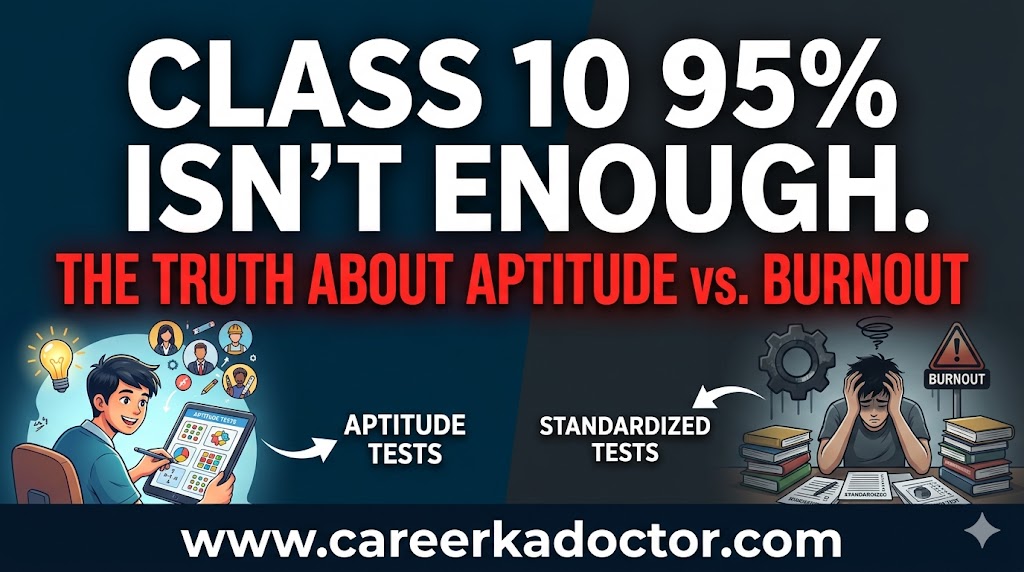
Career burnout after Class 10 in India is alarmingly common among high scorers because board exam marks measure memory and hard work — not innate aptitude or natural career fit. A student scoring 95% in PCB may power through NEET preparation and enter MBBS, only to feel chronically exhausted and unfulfilled within a few years because their natural aptitude profile was never suited for medicine. The Effort Index, a science-backed metric that quantifies how much cognitive strain a career demands relative to a student’s aptitudes, reveals why marks alone are a dangerously incomplete predictor of long-term career success.
- High board marks reflect discipline and preparation, not whether a career will feel natural or draining over a 40-year professional life.
- The Effort Index measures the gap between a student’s aptitude profile and the cognitive demands of a specific career — a low score means natural fit, a high score means chronic strain.
- Students with 95% in PCM/PCB regularly burn out in engineering and medicine because their strongest aptitudes (e.g., Linguistic, Spatial, Abstract) were never tested by board exams.
- Choosing a career based on aptitude alignment — not marks — reduces dropout rates, improves professional satisfaction, and prevents the burnout epidemic among India’s young professionals.
The 95% Trap: Why High Marks Create a False Sense of Career Burnout After Class 10 India
Every March, lakhs of Indian families celebrate Class 10 board results. A score of 95% or above is treated as a golden ticket — proof that the child is “brilliant” and destined for success in medicine, engineering, or chartered accountancy. Relatives call. Neighbours congratulate. Coaching institute banners go up. The assumption is simple and deeply ingrained: high marks mean the child can — and should — pursue the most competitive, prestigious career paths available.
But here is what the data tells us: India produces over 1.5 million engineering graduates annually, yet surveys consistently show that nearly 80% of engineers are unhappy in their jobs, and a significant percentage leave engineering entirely within five years. Medical professionals report some of the highest burnout rates globally, with Indian doctors showing alarming levels of emotional exhaustion even early in their careers. These are not students who lacked intelligence or marks. They are students for whom high marks masked a fundamental mismatch between their natural aptitude profile and the career they were pushed into.
What Board Exams Actually Measure
CBSE, ICSE, and State board exams are designed to assess curriculum comprehension, recall accuracy, and exam technique. A student who scores 95% in Science has demonstrated that they can memorise chemical equations, reproduce Physics derivations, and label biological diagrams under time pressure. What the exam does not measure is whether that student has high Mechanical aptitude (critical for engineering), strong Operational aptitude (essential for surgical precision in medicine), or the Abstract reasoning ability that separates a thriving researcher from a struggling one. Board marks test the floor — the minimum cognitive requirement — but tell you nothing about which ceiling a student can reach effortlessly in which career.
High Marks Low Career Satisfaction: The Stories Behind the Statistics
Consider a real pattern we see repeatedly: Riya scores 96% in Class 10 CBSE with PCB. Her family enrols her in NEET coaching. After two gruelling years, she clears NEET and enters a government medical college. By the second year of MBBS, she is struggling — not academically, but emotionally. Anatomy dissections feel mechanical. Patient interactions drain her. She pushes through internship but quietly applies for MBA programmes, losing five years and significant family savings. Her psychometric profile, had it been assessed in Class 9 or 10, would have shown exceptionally high Linguistic and Abstract aptitudes with moderate Operational and low Mechanical scores — a profile ideally suited for law, policy research, or behavioural economics, not clinical medicine.
Or take Arjun: 94% in PCM, enrolled in JEE coaching, joins an NIT in Computer Science. By third year, he is barely attending classes. His actual strengths were Spatial and Verbal aptitudes — he would have excelled in architecture, UX design, or filmmaking. But no one tested for aptitude. Everyone looked at the marks and declared, “PCM mein achhe marks hain, toh engineering le lo.”
Why Marks and Aptitude Are Not the Same Thing
Marks measure effort applied to a standardised syllabus. Aptitude measures the brain’s natural processing efficiency in specific cognitive domains. A student with moderate Numerical aptitude can score 95% in Mathematics through sheer hard work, coaching, and repetition — but that same student will find a career in actuarial science or quantitative finance perpetually exhausting because the daily cognitive demands exceed their natural processing speed. This is the difference between a career that feels like swimming downstream and one that feels like running uphill in sand — every single day, for decades.
The Effort Index: A Scientific Measure of Career Fit Beyond Marks
The Effort Index is a proprietary metric developed to quantify exactly this gap. It works by mapping a student’s measured aptitude profile across 7 validated aptitude types — Abstract, Numerical, Verbal, Operational, Mechanical, Linguistic, and Spatial — against the cognitive demand profile of specific careers. Each career requires a different combination and intensity of these aptitudes. The Effort Index score tells you, on a clear numerical scale, how much extra cognitive energy a student will need to sustain that career over time.
A low Effort Index (say, 15-25 on a 100-point scale) means the career is a natural fit — the student’s brain is wired for the daily demands of that profession. They will learn faster, perform with less stress, and sustain motivation over decades. A high Effort Index (say, 70-85) means the career is fundamentally misaligned with their wiring. They can still enter it — marks and entrance exams may allow it — but they will burn out. The question is not “Can my child get into this career?” but “Will my child thrive in this career without chronic exhaustion?”
Marks vs Aptitude Career India: What the Effort Index Reveals That Report Cards Cannot
When a student’s Class 10 marks say 95% in Science and the family assumes “doctor or engineer,” the Effort Index might reveal something completely different. It might show that the student’s lowest aptitude is Mechanical (ruling out most core engineering branches) and their highest aptitudes are Abstract and Linguistic (pointing toward careers in data science, behavioural research, journalism, or international relations). The marks cannot see this. The Effort Index can — because it is measuring the brain, not the syllabus.
Real Career Paths That 95% Scorers Should Consider But Never Do
One of the most damaging consequences of India’s marks-obsessed culture is the narrowing of career imagination. When a student scores above 90%, the conversation shrinks to three options: medicine (NEET), engineering (JEE), or commerce (CA/CS). In 2026, the Indian economy supports over 250 viable career paths that offer strong income potential, professional growth, and global mobility. Many of these — behavioural economics, computational linguistics, environmental policy, forensic accounting, UX research, sports analytics, patent law — are invisible to families who use marks as the sole decision-making tool.
A student with high Spatial and Abstract aptitudes and 95% in PCM might be a natural fit for computational geometry, robotic systems design, or game development — not traditional civil or mechanical engineering. A student with high Verbal and Linguistic aptitudes and 94% in PCB might thrive in medical writing, healthcare policy, or bioethics — not necessarily as a practising clinician. The Effort Index does not limit options; it expands them by showing where the student’s natural advantage lies.
The Cost of Ignoring Aptitude: Dropout Rates, Lateral Shifts, and Lost Years
India’s coaching industry is worth over ₹60,000 crore, and a significant proportion of that investment goes toward preparing students for careers that will never fit them. Families spend ₹3–8 lakh on NEET/JEE coaching alone. When a student enters the wrong career and pivots after 3-5 years — dropping out of MBBS for law school, leaving engineering for a design diploma — the financial and emotional cost is immense. A ₹3,000 psychometric assessment at the right time can prevent a ₹10-lakh course correction later. This is not an expense; it is insurance against career burnout after Class 10 India.
When Should You Actually Assess Your Child’s Aptitude?
The ideal window for a validated psychometric assessment is between Class 9 and Class 11 — before stream selection locks in and before coaching investments begin. In Class 9, the assessment helps guide stream choice (PCM vs PCB vs Commerce vs Humanities). In Class 10, it provides data for critical decisions about coaching, competitive exam preparation, and subject combinations in Class 11. In Class 11, it can course-correct early if a stream mismatch is already causing stress.
Waiting until Class 12 or after entrance exam results is a common mistake. By then, sunk-cost fallacy takes over — families feel they have invested too much in a particular path to change direction. The earlier the data is available, the more freedom the student has to align their choices with their natural strengths, reducing the probability of career burnout dramatically.
The Career Ka Doctor Approach to Effort Index
Career Ka Doctor’s validated psychometric assessment measures all 7 aptitude types (Abstract, Numerical, Verbal, Operational, Mechanical, Linguistic, and Spatial) alongside 28 personality traits to build a comprehensive cognitive and behavioural profile of each student. This is not a 10-minute online quiz — it is a rigorous, research-backed instrument that produces a personalised 60+ page report. The report includes 3 career recommendations ranked by the Effort Index, so families can see exactly which careers align with the student’s natural wiring and which ones will demand unsustainable effort over time.
Used by 23+ schools across India and the Middle East, Career Ka Doctor’s approach is built on the principle that every student has a unique aptitude signature — and the right career is the one that matches that signature, not the one that matches their marks. The assessment is followed by an expert counselling session where a trained career counsellor walks the family through the report, explains the Effort Index scores for each recommended career, and helps build a concrete academic roadmap. Learn more about how the assessment works, understand the Effort Index in detail, or book a free consultation to get started.
Career Ka Doctor’s complete assessment — 60+ page report + expert counselling session —
gives you data, not guesswork. Book a free consultation on WhatsApp today:
Frequently Asked Questions
Can a student with 95% in Class 10 still face career burnout in India?
Absolutely. Career burnout after Class 10 India is common among high scorers because board marks measure syllabus mastery and exam technique, not aptitude alignment with a specific career. A 95% scorer whose natural aptitudes don’t match the daily cognitive demands of medicine or engineering will experience chronic fatigue, disengagement, and burnout within a few years of entering that profession, regardless of how well they performed in school exams.
What is the Effort Index and how does it predict career satisfaction in 2026?
The Effort Index is a science-backed metric that measures the gap between a student’s natural aptitude profile (across 7 aptitude types) and the cognitive demands of a specific career. A low Effort Index score means the career is a natural fit and will feel sustainable over decades. A high score means the student will need to expend significantly more cognitive energy daily, leading to stress and burnout. In 2026, with over 250 viable career paths in India, the Effort Index helps families choose wisely rather than defaulting to marks-based assumptions.
My child scored 94% in PCB — should they automatically prepare for NEET?
Not necessarily. Scoring 94% in PCB means your child can handle the Class 10 Biology and Chemistry syllabus well, but MBBS and a medical career require specific aptitudes — particularly Operational aptitude (for procedural precision), strong Numerical reasoning, and specific personality traits like high stress tolerance. A validated psychometric assessment can determine whether your child’s aptitude profile actually supports a medical career or whether their strengths point toward other PCB-adjacent paths like biotechnology, environmental science, or healthcare management.
What is the difference between marks and aptitude in career planning India?
Marks reflect how well a student has prepared for a specific exam — they measure effort, memory, and exam strategy. Aptitude measures the brain’s natural processing speed and efficiency in specific cognitive domains like numerical reasoning, spatial visualization, or verbal analysis. In career planning, marks tell you what a student has achieved in the past; aptitude tells you what careers will feel natural and sustainable in the future. The distinction between marks vs aptitude career India is critical because a career built on aptitude requires less effort and produces greater long-term satisfaction.
When is the best time to take a career aptitude test for my child — Class 9, 10, or 11?
The ideal window is Class 9 or early Class 10, before stream selection decisions are made and before families commit ₹3–8 lakh to coaching programmes. An assessment at this stage gives maximum flexibility — the student can choose the right stream (PCM/PCB/Commerce/Humanities) based on data, not assumptions. Class 11 assessments are still valuable for course-correction, but the earlier you test, the more time and money you save by avoiding misaligned career paths.
Why do toppers in India often end up unhappy in their careers?
Toppers are often the most disciplined and hard-working students, which means they can force themselves through any syllabus or entrance exam — regardless of aptitude fit. This creates a dangerous pattern: they succeed at getting into prestigious programmes (IITs, AIIMS, top CA firms) but struggle with the daily reality of the profession because their natural cognitive strengths lie elsewhere. The result is high marks but low career satisfaction — a pattern that affects lakhs of Indian professionals who were never assessed for aptitude before making career decisions.