If your child did not clear NEET 2026 or scored far below expectations, the most critical step you can take right now is to pause, breathe, and avoid making a rushed, panic-driven decision. Seeing a low score after years of relentless preparation can feel crushing for any family, but understanding what to do if failed NEET 2026 starts with recognising one fundamental truth: a single entrance exam score does not define your child’s worth, intelligence, or future success.
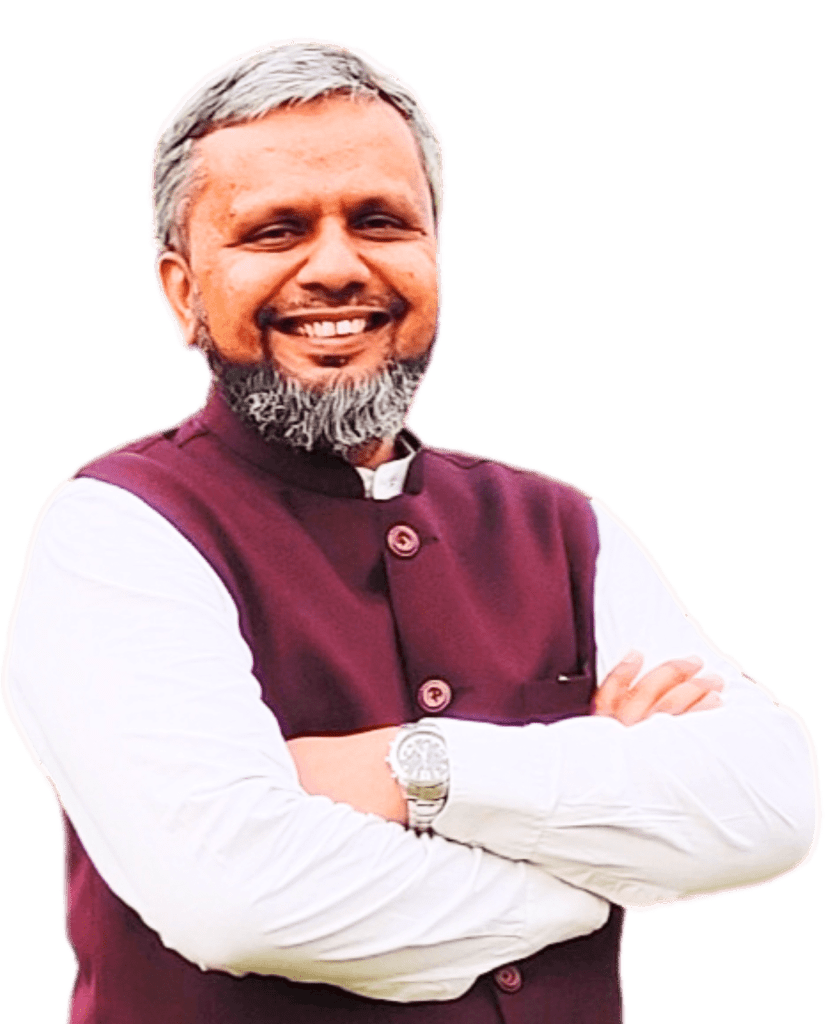
Over my 25 years of career counselling, during which I have guided more than 5 lakh students and parents across 120+ cities, I have seen thousands of students who “failed” NEET go on to build extraordinary, high-paying careers in allied healthcare, research, biotechnology, data science, and technology. Your child’s medical dream may need a strategic pivot, but their potential remains completely intact.
• Avoid the 48-Hour Panic Trap: The worst career decisions, such as booking an expensive repeater batch in panic, happen right after results are announced.
• MBBS Is Not the Only Healthcare Path: High-growth fields like BDS, BAMS, BHMS, BSc Nursing, Physiotherapy (BPT), Pharmacy, and Biomedical Engineering offer outstanding stability and financial success.
• A Drop Year Needs Science, Not Emotion: Reattempting NEET makes sense only if your score gap is bridgeable (within 50 to 80 marks) and your child has the mental resilience for another intense year.
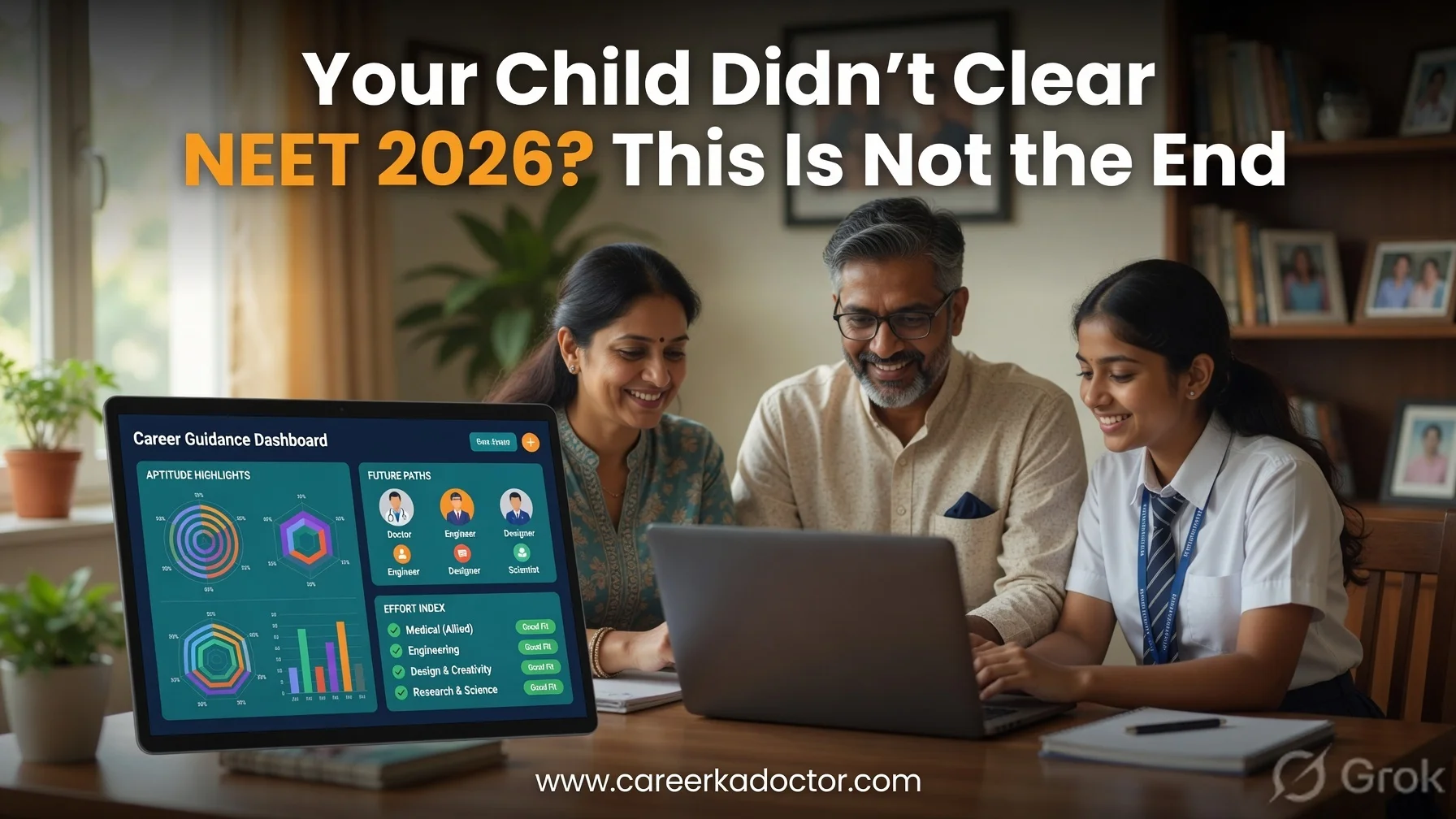
• Align with Natural Aptitude: Using a validated Psychometric Assessment and measuring the Effort Index ensures your child moves into a career where they excel naturally without burning out.
The First 48 Hours After NEET Results: Why Avoiding Panic Decisions Is Critical
Having counselled families through every NEET result cycle for over two decades, I know how heavy the atmosphere at home can get. Silence in the house, fear of societal judgment, and unsolicited calls from relatives often drive parents into survival mode.
In this state of anxiety, families frequently make one of two costly mistakes:
- Rushing into a Repeater Batch: Enrolling in an expensive coaching institute the very next morning without asking whether the child has the emotional readiness or aptitude for another 12 months of intense pressure.
- Accepting Unrecognised Foreign Medical Seats: Falling into the trap of aggressive educational agents promising guaranteed MBBS degrees abroad in substandard institutions.
Take a step back. Give your child emotional reassurance rather than criticism. Let them know that you stand by them regardless of a rank card.
Why Not Clearing NEET Is Often a Hidden Blessing
With over 22 lakh aspirants competing for approximately 1.08 lakh total MBBS seats in 2026, the mathematical reality in India is stark: more than 95% of hardworking students will not get a government MBBS seat.
Many students who push themselves to the breaking point forcing an MBBS path actually possess cognitive wiring far better suited for other flourishing sectors. When a student operates in a field that matches their natural strengths, their work feels rewarding rather than draining.
High-Growth Career Paths Beyond MBBS for PCB Students
If your child did not secure an MBBS seat, their preparation in Physics, Chemistry, and Biology has not gone to waste. India’s healthcare and life sciences sector is expanding at over 20% annually, creating high demand across multiple non-MBBS disciplines.
1. Alternative Medical Systems (BAMS, BHMS, BDS)
- BDS (Dental Surgery): A direct, respected 5-year degree requiring NEET scores. Ideal for students with high spatial ability and manual dexterity.
- BAMS (Ayurveda) and BHMS (Homeopathy): Backed by strong institutional support and growing global demand, these degree courses accept NEET scores at cutoffs much lower than MBBS.
Read our detailed guide: Alternative Medicine Careers After NEET 2026: BDS, BAMS, BHMS Explained
2. Allied Health Sciences (BPT, BSc Nursing, B.Pharm)
- Physiotherapy (BPT): A hands-on, high-demand profession in sports rehabilitation, neurology, and corporate wellness.
- Pharmacy (B.Pharm): Blends healthcare, organic chemistry, and pharmaceutical business. Excellent entry path into clinical research and pharmaceutical management.
- BSc Nursing: Global shortages of medical staff have made professional nursing one of the fastest routes to international healthcare careers in countries like Germany, the UK, and Canada.
3. Modern Interdisciplinary Fields (Biotechnology and Biomedical Engineering)
- Biotechnology and Bioinformatics: Perfect for students who excel in research, analytical problem-solving, and laboratory environments.
- Biomedical Engineering: Merges biology with technology, focusing on medical device design, AI diagnostics, and prosthetics.
See our full list: Best Courses After NEET 2026 for Students Who Did Not Get MBBS
Should Your Child Drop a Year for NEET 2027?
A drop year should never be chosen out of guilt or social pressure. Before enrolling in a reattempt program, evaluate whether your child meets these three essential conditions:
- Bridgeable Score Gap: Did your child score within 50 to 80 marks of the qualifying cutoff? Closing a 60-mark gap in a year is realistic; bridging a 300-mark gap requires an extraordinary shift that often leads to severe burnout.
- Intrinsic Motivation: Is the desire to repeat coming from the student’s inner drive, or from your expectations as a parent?
- Mental Resilience: Can your child handle another 12 months of isolated, repetitive exam preparation without damaging their mental well-being?
How Career Ka Doctor Helps Families Find the Right Path
At Career Ka Doctor, we do not believe in generic career advice or emotional guesswork. We use a scientific, data-backed approach to help families navigate post-NEET choices with complete clarity.
- 7 Aptitude Types and 28 Personality Traits: Our comprehensive Psychometric Assessment measures core cognitive traits including verbal, numerical, abstract, spatial, and operational aptitudes.
- The Effort Index Metric: We calculate the exact gap between your child’s natural wiring and the demands of various professions. A low Effort Index path means your child progresses smoothly and excels with natural energy instead of fighting their own brain.
Frequently Asked Questions
What should I do if my child failed NEET 2026 and feels depressed?
Provide immediate emotional support and remove all pressure regarding immediate career choices. Reassure them that NEET is only one path among hundreds. Once emotional stability is restored, schedule a Psychometric Assessment to objectively explore high-suitability career options.
Is it worth taking a second drop year for NEET?
A second drop year is recommended only if the student’s score in their first reattempt was very close to the cutoff and their psychometric profile shows high abstract and numerical aptitude along with high mental resilience. Otherwise, exploring alternative medical and healthcare degrees is statistically a much safer, faster route to career success.
Can my child build a successful career in healthcare without MBBS?
Yes, absolutely. Professions in Biotechnology, Physiotherapy, Pharmacy, Health Data Analytics, and Biomedical Engineering offer starting salaries ranging from Rs 4 to Rs 10 lakh per annum, with rapid growth opportunities in India and abroad.
How do I know which alternative course suits my child best?
Choosing an alternative degree based on cutoff marks alone is a mistake. A student with strong interpersonal traits will thrive in BDS or Physiotherapy, while a student who prefers analytical problem-solving will excel in Biotechnology or Clinical Research. A validated Psychometric Assessment maps these traits precisely.
Take our free Career Quiz for Parents and get personalised guidance based on your child’s strengths and aptitude.
Or book a free 10-minute career clarity call directly with our senior counsellors.