
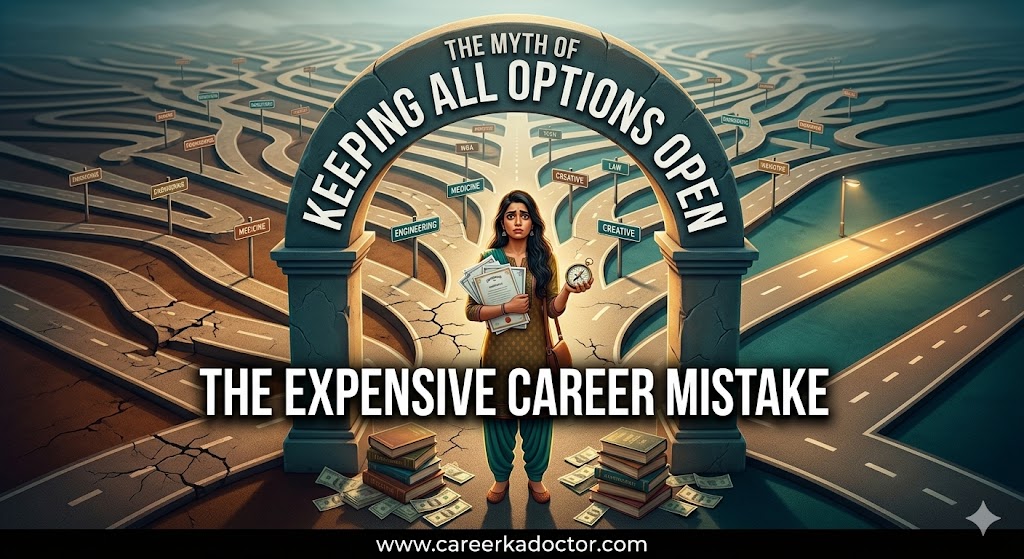
Every year I hear the same line from anxious parents in Bengaluru, Delhi, Mumbai, Hyderabad and Pune: “We don’t want to close any options for our child. Let’s keep everything open.” After 25+ years and guiding more than 5 lakh students, I can say with complete honesty — this approach is one of the most expensive and stressful career mistakes Indian families make.
- “Keeping all options open” usually means choosing PCM without checking natural fit
- This leads to High Challenge careers and unnecessary stress for most students
- Early, data-driven decisions save years of struggle and lakhs of rupees
- The Effort Index helps families choose focused, high-success paths instead of scattered options
Why “Keeping All Options Open” Feels Safe But Is Actually Risky
Indian parents want the best for their children. The fear of limiting future possibilities is natural and comes from a place of love. So they push their child into PCM after Class 10 thinking it keeps engineering, medicine, commerce, and everything else open. In reality, this decision often locks the child into a high-pressure path that may not suit their natural strengths at all.
When students take PCM solely to keep options open, they usually face intense JEE or NEET coaching. If their aptitude profile does not support heavy demands on Numerical Aptitude, Abstract Reasoning or Mechanical Aptitude, they spend years swimming upstream. The emotional toll is heavy and often hidden from parents until it becomes too late.
Many families I meet believe this strategy is safe, but it frequently leads to scattered preparation, average performance across multiple fronts, and eventual regret. The cost is not just financial — it includes lost confidence, delayed clarity, and years of unnecessary stress during the most formative period of a child’s life.
True safety comes from alignment, not from trying to cover every possible path. A validated psychometric assessment helps families see which options are genuinely worth keeping open and which ones would be a waste of precious time and energy.
The Real Cost of the “All Options Open” Strategy
When a student takes PCM just to keep options open, they often end up preparing for multiple competitive exams with intense coaching. If their profile shows only moderate Numerical Aptitude, the Effort Index quickly moves into High Challenge territory. The result is burnout, anxiety, lower performance than potential, and sometimes even dropping out or switching streams later at great emotional and financial cost.
I met a family in Chennai whose son scored 94% in Class 10. They chose PCM to “keep options open.” His psychometric assessment later revealed high Verbal Ability, high Linguistic Aptitude and strong Spatial Ability but only moderate Numerical Aptitude. He struggled badly in JEE coaching. By Class 12 he was exhausted and demotivated. The family had spent nearly ₹4 lakh on coaching. Had they chosen a more aligned stream earlier, he could have saved those years and that money while feeling much happier.
This pattern repeats across many cities. Families invest heavily in coaching, tuition, and test series hoping to keep doors open, only to discover later that most doors were never realistic for their child’s natural profile. The hidden cost is the child’s mental health and the family’s peace of mind.
Early assessment prevents this expensive mistake by showing clearly which focused path offers the best return on effort and happiness.
What the Psychometric Assessment Actually Reveals
Our validated psychometric assessment measures the 7 aptitude types — Abstract Reasoning, Numerical Aptitude, Verbal Ability, Operational Thinking, Mechanical Aptitude, Spatial Ability and Linguistic Aptitude — along with 28 personality traits. This data, combined with the Effort Index, shows clearly which path will allow the child to flow downstream with natural energy. You can explore the concept further here: Effort Index explained.
Keeping all options open often results in a High Challenge career. Choosing a focused path based on real strengths frequently leads to Lesser Challenge or Moderate Challenge outcomes — faster growth, higher satisfaction and better mental health.
The assessment removes guesswork and gives families confidence to make decisive, strength-based choices instead of fear-driven scattered ones.
After seeing thousands of such cases, I am convinced that clarity beats confusion every single time.
Better Approach: Focused Excellence Over Scattered Options
Instead of trying to keep every door open, the wiser strategy is to identify the doors that naturally align with your child’s profile and walk through them with confidence. A student with strong Spatial Ability and Creativity may do far better in Architecture or Design than in core engineering. A student with high Operational Thinking and Verbal Ability may shine in Commerce + Law or Management.
The 60+ page personalised report gives clear, ranked recommendations so families can make confident, focused decisions instead of fear-based scattered choices.
In my work with 23+ partner schools, families who moved from “all options” thinking to strength-aligned choices reported dramatically better outcomes — both academically and emotionally.
This focused approach honours the child’s unique design rather than forcing them into a mould that doesn’t fit.
Get objective clarity with a validated psychometric assessment and receive a detailed 60+ page personalised report with Effort Index guidance.
The myth of keeping all options open creates more anxiety than security. True security comes from understanding your child’s natural strengths early and choosing a path that lets them flow downstream. When Indian families embrace this truth, they replace fear with confidence and give their children the best possible foundation for a fulfilling career.
Frequently Asked Questions
Is it bad to take PCM to keep options open?
It is not bad if the child’s Effort Index shows Lesser or Moderate Challenge in PCM-related careers. For most students it becomes High Challenge and creates unnecessary stress.
What if my child is genuinely good at everything?
Very few students have a complete-spectrum aptitude profile. Even then, personality traits and Effort Index help identify the path of least resistance and highest satisfaction.
Can we change streams later if we keep options open now?
Changing streams after Class 11 is difficult and costly. Early assessment helps avoid this situation completely.
How early should we do the psychometric assessment?
Class 9 or early Class 10 is ideal — before the pressure of stream selection begins.
Does keeping options open affect mental health?
Yes. Constant pressure of multiple competitive exams often leads to anxiety and burnout. Focused paths reduce this significantly.
How do I convince my family to stop keeping all options open?
Share the Effort Index concept and real examples from the 60+ page personalised report. Focus on long-term happiness and success rather than short-term prestige.