
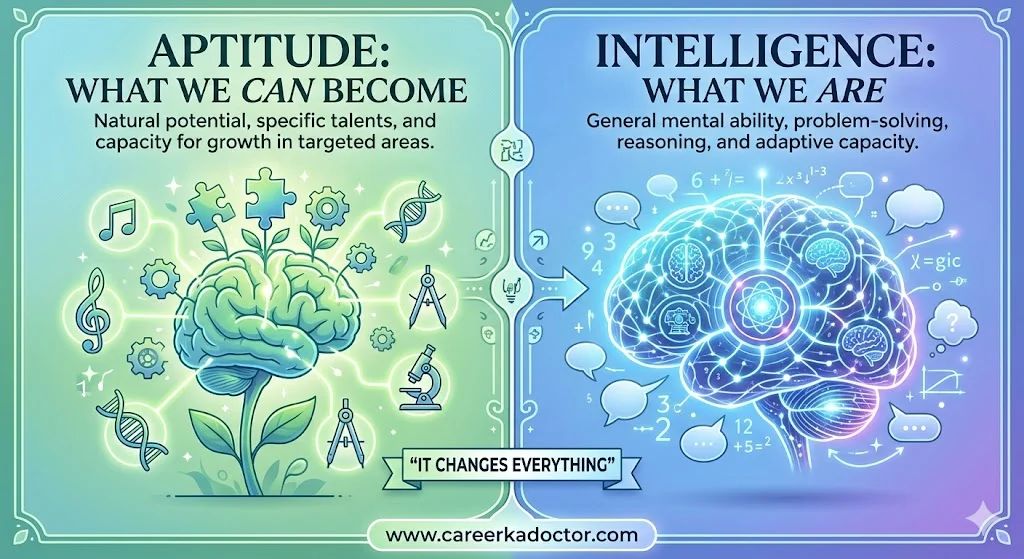
Parents often tell me “My child is very intelligent, so he should do well in any career.” After 25+ years of experience, I gently explain that intelligence and aptitude are different. Understanding this distinction has transformed career decisions for thousands of families I have guided.
- Intelligence is general cognitive ability while aptitude is specific innate strength
- High intelligence with mismatched aptitude often leads to High Challenge careers
- The 7 aptitude types predict long-term success better than general intelligence
- Effort Index combines aptitude and personality for practical career guidance
The Common Confusion Between Intelligence and Aptitude
Many Indian parents equate high board marks or quick learning with overall intelligence and assume it guarantees success in competitive fields like engineering or medicine. In reality, intelligence is a broad measure while aptitude refers to specific cognitive strengths that determine how easily a person masters particular types of tasks.
A student may have high general intelligence but low Spatial Ability, making architecture or surgery difficult despite being “bright.” Another may have average intelligence scores but exceptional Operational Thinking, making them outstanding in project management or supply chain roles.
This distinction becomes critical during stream selection. Relying only on intelligence or marks leads to poor long-term outcomes. Aptitude-based guidance using validated tools provides far more accurate predictions.
In my sessions across 4 countries, explaining this difference has helped parents move from confusion to clarity and from pressure to informed confidence.
How the 7 Aptitude Types Differ from General Intelligence
Our validated psychometric assessment measures seven specific aptitudes: Abstract Reasoning, Numerical Aptitude, Verbal Ability, Operational Thinking, Mechanical Aptitude, Spatial Ability and Linguistic Aptitude. These are more predictive of career success than general intelligence alone because real careers demand specific combinations of these abilities.
General intelligence helps with learning new things broadly, but specific aptitudes determine how enjoyable and sustainable that learning will be over many years. A child with high intelligence but low Mechanical Aptitude may struggle in core engineering despite coaching.
Personality traits (28 in total) further modify how these aptitudes express themselves in daily work. The Effort Index integrates both for a complete picture.
This deeper understanding has prevented many families from making expensive mismatches based solely on report cards or IQ-like perceptions.
Why This Difference Changes Career Planning Completely
When parents understand aptitude versus intelligence, they stop forcing children into prestigious streams that don’t match their profile. Instead, they discover paths where the child can excel naturally with less effort and more joy.
I recall a student from Pune labelled as “highly intelligent” by teachers but struggling in PCM. His assessment showed high Verbal and Linguistic Aptitude but moderate Numerical and Mechanical. Shifting focus to law or content strategy changed his entire trajectory. He went from average performance to standing out because he was finally using his real strengths.
This shift saves families lakhs of rupees in coaching and years of stress. More importantly, it preserves the child’s self-esteem and motivation for lifelong learning.
The 60+ page personalised report makes this distinction practical and actionable for Indian families.
Practical Implications for Stream and Career Choice
Understanding aptitude helps parents choose streams and careers that leverage strengths rather than constantly compensating for weaknesses. This leads to better academic performance, lower stress, and higher long-term satisfaction.
High intelligence students in mismatched fields often underperform relative to their potential. When placed in aligned fields, they shine brightly and sustainably.
The Effort Index translates this scientific understanding into simple guidance that families can act upon confidently before Class 11.
After guiding 5 lakh+ students, I am convinced that aptitude-aware planning is one of the greatest gifts we can give the next generation.
Book a free consultation and receive a detailed 60+ page personalised report that distinguishes aptitude from general intelligence.
The difference between aptitude and intelligence is subtle but life-changing. Intelligence opens many doors, but aptitude determines which doors will feel natural and lead to lasting success and happiness. When Indian parents embrace this truth, they move from generic pressure to personalised guidance that truly serves their child’s unique potential.
Frequently Asked Questions
Does high intelligence guarantee career success?
No. Many highly intelligent students struggle in mismatched careers. Aptitude alignment matters more for long-term success.
Can aptitude change over time?
Aptitudes stabilise by age 14. Early assessment gives reliable long-term guidance.
How is aptitude measured differently from school exams?
School exams test learned content and memory. Aptitude tests measure innate cognitive strengths.
What if my child has high intelligence but low aptitude in desired field?
The Effort Index will flag it as High Challenge. We help explore better-aligned alternatives.
Is the psychometric assessment like an IQ test?
No. It is much broader, covering 7 specific aptitudes and 28 personality traits for career relevance.
How soon should we assess aptitude?
Class 9 or early Class 10 is ideal for stream selection decisions.