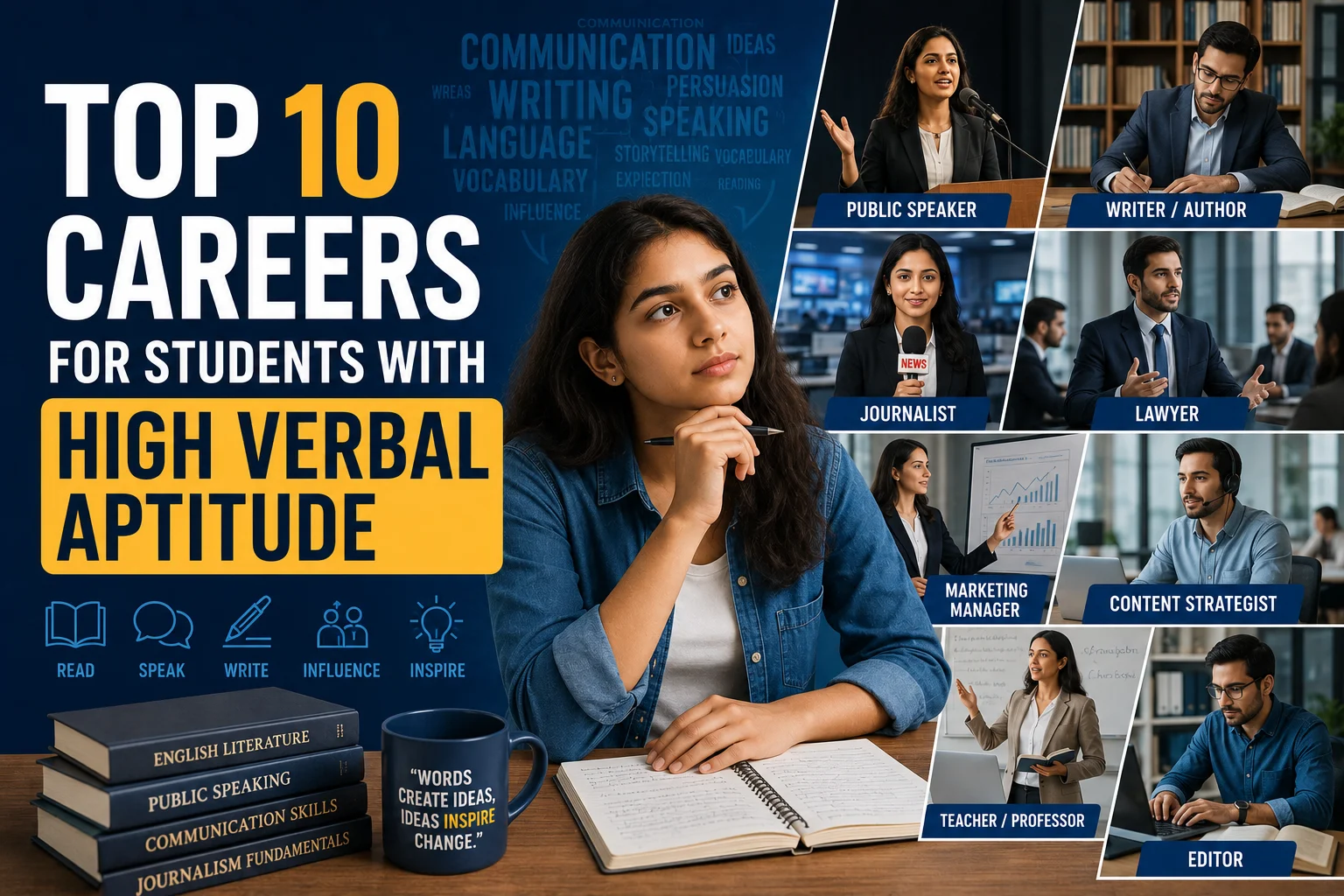
The top verbal aptitude careers for students in India include law, journalism, content strategy, civil services, clinical psychology, public relations, teaching, advertising copywriting, publishing, and corporate communications — all fields where the ability to understand, interpret, and produce language is a daily competitive advantage. If your child scores high on verbal reasoning in a validated psychometric assessment, these 10 careers offer a natural fit that reduces effort and accelerates professional growth. Below, we break down each career path with realistic education routes, expected salaries, and entrance requirements relevant to Indian students in 2026.
- Verbal aptitude is not just about “being good at English” — it measures comprehension speed, logical interpretation of text, vocabulary depth, and persuasive communication ability.
- Students with high verbal reasoning have a natural edge in 10+ professional fields, many of which are among India’s fastest-growing career sectors in 2026.
- The right stream choice in Class XI (Humanities, Commerce, or even Science) can open or close doors to these careers — early identification matters.
- A science-backed assessment measuring verbal aptitude alongside 6 other aptitude types and 28 personality traits gives the most accurate career direction.
What Exactly Is Verbal Aptitude — and Why Does It Matter for Career Selection?
Verbal aptitude refers to a student’s innate ability to process written and spoken language with speed, accuracy, and depth. It is not the same as “being good at English in school.” A student may score 90% in English but have moderate verbal aptitude, while another student who reads voraciously and argues persuasively may not top the class but possess exceptional verbal reasoning. Psychometric assessments distinguish between learned knowledge and natural cognitive processing ability — and that distinction is critical for career planning.
In practical terms, high verbal aptitude means a student can quickly grasp the meaning of complex texts, construct logical arguments, detect nuance and ambiguity in language, and communicate ideas with clarity. These are not soft skills that can be “picked up later.” They are foundational cognitive strengths. When a student chooses a high verbal reasoning career, they spend less mental energy on the core demands of the job, leaving more bandwidth for creativity, strategy, and professional growth. This is what Career Ka Doctor calls the Effort Index — the measurable gap between a student’s natural aptitude profile and the cognitive demands of a specific career.
Top 10 Verbal Aptitude Careers for Indian Students in 2026
1. Law (Litigation, Corporate Law, Policy)
Law is arguably the most natural career for verbal learners India has to offer. Every aspect of legal practice — reading case law, drafting contracts, arguing before judges, negotiating settlements — is an exercise in verbal precision. The education path is clear: after Class XII (any stream), students can take CLAT or AILET for five-year integrated BA LLB / BBA LLB programmes at National Law Universities. Alternatively, after any undergraduate degree, a three-year LLB is an option. Starting salaries at top law firms in 2026 range from ₹12–25 lakh per annum, and litigation practice in courts offers unlimited income potential over time.
2. Journalism and Mass Communication
Print, digital, and broadcast journalism require relentless verbal processing — interviewing sources, writing under deadline pressure, editing copy for clarity, and translating complex events into accessible language. Students can pursue BA in Journalism from institutions like IIMC, Symbiosis, or ACJ Chennai after Class XII (Humanities or Commerce preferred). The industry is shifting heavily toward digital media, creating new roles like investigative data journalism and podcast production. Entry-level salaries range from ₹4–8 lakh, but experienced journalists in senior editorial or anchor roles earn ₹15–40 lakh or more.
3. Content Strategy and UX Writing
One of the fastest-growing verbal aptitude careers in 2026, content strategy involves planning, creating, and optimising written content for digital platforms. UX writers craft the microcopy inside apps and websites — every button label, error message, and onboarding screen. A bachelor’s degree in English, Communications, or even Psychology provides a good foundation. Many professionals build portfolios through internships and freelance projects. Salaries at Indian tech companies and startups range from ₹6–18 lakh at mid-career, with senior strategists earning ₹25 lakh and above.
4. Indian Administrative Service (IAS) and Civil Services
The UPSC Civil Services Examination is, at its core, a test of verbal and analytical ability. The Prelims, Mains, and Interview stages all reward students who can read vast quantities of material, synthesise arguments, and express nuanced positions in writing. Any graduate can appear for UPSC, but students with high verbal aptitude have a structural advantage in essay writing, General Studies answer construction, and the personality test. The recommended path: complete graduation (BA in Political Science, History, Sociology, or Economics is popular), then begin UPSC preparation by age 21–22.
5. Clinical Psychology and Counselling
Psychology professionals spend their careers listening, interpreting, and communicating — all deeply verbal activities. Therapeutic modalities like Cognitive Behavioural Therapy (CBT) rely on precise verbal reframing of thoughts. Students should take PCB or Humanities in Class XI, then pursue BA Psychology followed by MA Psychology or M.Phil in Clinical Psychology (RCI-licensed). India faces a severe shortage of licensed psychologists — the demand-supply gap makes this one of the most promising careers for verbal learners India will see grow through the next decade. Private practice psychologists in metros earn ₹8–30 lakh depending on experience and specialisation.
6. Public Relations and Corporate Communications
PR professionals craft press releases, manage brand narratives during crises, build media relationships, and shape public perception — all tasks demanding exceptional verbal fluency. After Class XII, students can pursue BMM, BA in Public Relations, or BA in English, followed by an MBA or PGDM in Marketing/Communications. Major PR agencies in India (Adfactors, Edelman India, Genesis BCW) hire graduates at ₹5–9 lakh, with directors earning ₹20–50 lakh.
7. Teaching and Education (Higher Education / Ed-Tech)
Teaching at any level demands verbal aptitude, but higher education and ed-tech content development especially reward it. Professors must explain complex ideas clearly, moderate discussions, write research papers, and mentor students — all verbal-heavy tasks. The path involves graduation, post-graduation, and NET/SET qualification for college teaching. Ed-tech companies like Physics Wallah, Unacademy, and BYJU’S hire subject matter experts and instructional designers at ₹6–15 lakh, with top educators earning significantly more.
8. Advertising Copywriting and Brand Strategy
Every compelling tagline, brand campaign, and social media post you see was written by someone with high verbal aptitude. Copywriting is the art of persuasion through words. Students can pursue BA in English, Mass Communication, or even Commerce, followed by short courses from institutions like Miami Ad School or portfolio development through internships. Junior copywriters at agencies earn ₹4–7 lakh, while senior creative directors at firms like Ogilvy or Leo Burnett earn ₹25–60 lakh.
9. Publishing and Editorial Management
India’s publishing industry — including academic publishing, trade books, and digital publications — employs commissioning editors, developmental editors, literary agents, and rights managers. All these roles require the ability to evaluate manuscripts, provide structural feedback, and manage language quality at scale. A BA in English Literature or Humanities is the most common starting point, with specialised postgraduate diplomas in publishing from institutions like the Seagull School of Publishing. Salaries range from ₹4–8 lakh at entry level to ₹15–25 lakh for senior editorial directors at major publishing houses.
10. Diplomacy and International Relations
Diplomats negotiate treaties, draft policy positions, represent India at multilateral forums, and communicate complex geopolitical positions — all demanding elite verbal skills. The Indian Foreign Service (IFS) is accessed through the same UPSC examination as IAS. Alternatively, students can pursue careers in international think tanks, the United Nations system, or international NGOs. The education path typically involves BA in Political Science, International Relations, or Economics, followed by MA and UPSC preparation. IFS officers earn ₹8–15 lakh initially, with significant perks including international postings and housing.
How to Choose Between These Verbal Aptitude Careers
High verbal aptitude alone does not point to a single career. A student with high verbal aptitude AND high abstract reasoning might thrive in law or policy analysis, where logical argumentation meets language. A student with high verbal aptitude AND strong linguistic ability (a related but distinct aptitude measuring sensitivity to language structure and nuance) may find copywriting or literary editing more naturally fulfilling.
This is why aptitude must be assessed alongside personality traits. A verbally gifted student who is introverted and detail-oriented will experience journalism — with its constant social interaction and deadline chaos — very differently from an extroverted, spontaneous student. Twenty-eight personality dimensions, when combined with 7 aptitude scores, create a multidimensional profile that narrows down not just broad career fields, but specific roles within them.
The Stream Choice Connection: Class XI Decisions That Matter
For Indian students, the Class XI stream decision is the first major career filter. Here is how verbal aptitude careers map to streams:
Humanities (Arts): Law (via CLAT), Civil Services, Journalism, Psychology, Teaching, Diplomacy, Publishing — the broadest access to verbal careers. Commerce: Corporate Communications, PR, Advertising, some law programmes (BBA LLB). Science (PCM/PCB): Keeps medical and engineering options open, but students must pivot after graduation for most verbal careers. If a student’s primary aptitude is verbal (not numerical or spatial), choosing Science “just to keep options open” often leads to unnecessary struggle and disengagement.
Parents frequently ask: “Should my child take Science even if their verbal aptitude is higher?” The honest answer is: only if their secondary aptitudes (numerical, abstract) are also strong enough to handle the Science curriculum without excessive effort. Otherwise, the student spends two critical years fighting against their natural cognitive grain — time better spent building strengths.
The Career Ka Doctor Approach to Career Guidance
Career Ka Doctor’s validated psychometric assessment measures all 7 aptitude types — Abstract, Numerical, Verbal, Operational, Mechanical, Linguistic, and Spatial — alongside 28 personality traits. This is not a quiz or a preference survey. It is a timed, standardised cognitive assessment that produces a 60+ page personalised report for each student. The report includes 3 specific career recommendations ranked by natural fit using the Effort Index, which quantifies how much cognitive effort a student would need to expend in a given career versus how much comes naturally.
For a student with high verbal aptitude, the assessment does not simply say “you are verbal, try law.” It analyses whether their personality traits (risk tolerance, need for structure, social orientation, creative drive) align with litigation versus policy work versus journalism versus counselling. It also identifies secondary aptitudes that open hybrid career paths — for example, high verbal + high spatial might point to architecture criticism, museum curation, or UX research. The assessment is currently used by 23+ schools across India and the Middle East. You can learn more about how the assessment works or book a free consultation to discuss your child’s specific situation.
Career Ka Doctor’s complete assessment — 60+ page report + expert counselling session —
gives you data, not guesswork. Book a free consultation on WhatsApp today:
Frequently Asked Questions
What are the best verbal aptitude careers for students in India in 2026?
The best verbal aptitude careers in India in 2026 include law, journalism, civil services (IAS/IFS), clinical psychology, content strategy, public relations, advertising copywriting, teaching, publishing, and diplomacy. Each of these fields requires strong verbal reasoning as a core daily skill, giving naturally verbal