
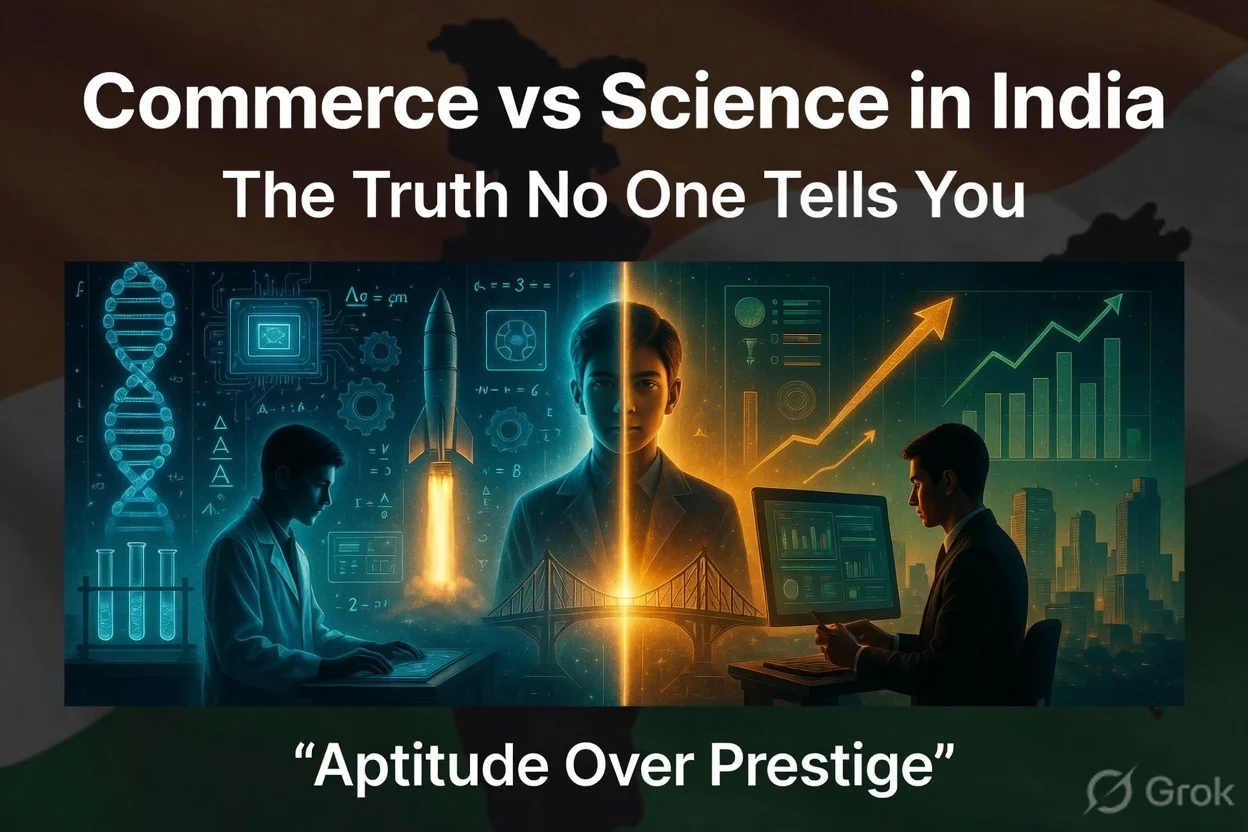
The debate around commerce vs science India is almost always framed around prestige and salary — but the real deciding factor should be your natural aptitude profile. Science demands high abstract, numerical, and spatial reasoning, while Commerce rewards strong numerical, verbal, and operational aptitudes. Neither stream is universally “better”; the right choice is the one that aligns with how your brain naturally works, reducing effort and increasing long-term career satisfaction.
- Science and Commerce require fundamentally different aptitude combinations — choosing based on marks alone ignores this reality.
- Over 60% of Indian students who switch streams after Class XII cite “wrong initial choice” as the reason, often because aptitude was never assessed.
- Commerce careers (CA, CFP, investment banking) can match or exceed Science career salaries — the “Science pays more” myth is outdated.
- A validated psychometric assessment measuring aptitudes and personality traits is the most reliable way to make this decision before Class XI.
Commerce vs Science India: Why the Entire Debate Is Framed Wrong
Every year, roughly 1.5 crore Indian students face the same crossroads after Class X: Science or Commerce? And every year, the conversation follows a predictable script. Relatives say, “Science rakhlo, scope zyada hai.” Coaching centres push PCM because JEE means revenue. Parents compare their child’s board marks against a cousin who “got into IIT.” Almost no one asks the question that actually matters: What is this child naturally wired to do?
The stream comparison India families obsess over is fundamentally a prestige contest, not a career planning exercise. When we look at actual labour market data from 2024–2025, Chartered Accountants at Big Four firms earn ₹12–18 LPA within three years of qualification. Investment bankers from top Commerce backgrounds command ₹25–50 LPA within five years. Meanwhile, the median salary for a B.Tech graduate from a non-IIT/NIT college hovers around ₹3.5–5 LPA. The “Science equals money” equation simply does not hold unless you land in the top 2% of institutions. The real question isn’t which stream is better science or commerce — it’s which stream is better for your child.
The Aptitude Profiles: What Science and Commerce Actually Demand
Every academic stream places different cognitive demands on a student. Understanding these demands is the first step in making a rational, data-backed decision instead of an emotional one.
Science Stream (PCM/PCB): The Aptitude Blueprint
Physics, Chemistry, and Mathematics require a potent combination of abstract reasoning (the ability to identify patterns, think in theoretical frameworks), numerical aptitude (comfort with complex calculations and quantitative logic), and spatial aptitude (visualising 3D structures, understanding geometry, interpreting diagrams). PCB students additionally need strong verbal aptitude for biology’s descriptive and terminological depth, and often mechanical aptitude for understanding physiological systems. A student with moderate abstract reasoning but outstanding numerical skills may survive Maths but struggle deeply with Physics — a nuance that board marks in Class X cannot capture.
Commerce Stream: The Aptitude Blueprint
Accountancy, Business Studies, and Economics lean heavily on numerical aptitude (but of a different flavour — financial reasoning, data interpretation, statistical thinking), verbal aptitude (comprehension of laws, business theory, case studies), and operational aptitude (systematic thinking, process orientation, attention to detail). Students who thrive in Commerce often exhibit strong organisational personality traits — conscientiousness, methodical thinking, and comfort with structured frameworks. The linguistic aptitude also becomes critical for students aiming at law (after a Commerce + CLAT pathway) or civil services.
The Effort Index: A Smarter Way to Compare Streams
Imagine two students, Aarav and Meera, both scoring 92% in Class X CBSE boards. Aarav has high abstract and spatial aptitude but average numerical skills. Meera has outstanding numerical and operational aptitude but moderate abstract reasoning. If both choose Science (PCM) — as Indian families almost always encourage — Aarav will likely perform well in Physics but struggle in computational Mathematics. Meera will handle calculation-heavy portions but hit a wall in conceptual Physics and higher-order problem-solving in JEE. Neither student’s experience is predicted by their Class X percentage.
This is where the concept of the Effort Index becomes transformative. The Effort Index measures how much cognitive effort a student must exert to succeed in a given career or academic path relative to their natural aptitude profile. A low Effort Index means the path aligns with innate strengths — the student learns faster, retains more, and experiences less burnout. A high Effort Index means the student is constantly swimming against the current. In the commerce vs science India debate, the Effort Index replaces speculation with measurement: it tells you, with data, which stream will feel like a natural fit and which will feel like a daily grind.
For Meera, a Commerce pathway leading to CA or CFA would produce a significantly lower Effort Index than a PCM-to-engineering route. For Aarav, Science with a focus on design engineering or architecture (leveraging spatial aptitude) would be the smarter bet. Same marks. Completely different optimal paths.
Salary Myths vs Reality: Commerce and Science Careers in 2026
Let’s confront the elephant in the room with actual numbers. Indian families often assume Science careers universally out-earn Commerce careers. Here is a reality check based on 2024–2025 placement data and professional salary surveys:
Science-Side Careers
Software Engineer (B.Tech, CS): Median salary from top-50 colleges is ₹8–14 LPA; from colleges ranked 100+, it drops to ₹3–5 LPA. Doctor (MBBS + MD): After 10+ years of education and training, starting salaries at private hospitals range from ₹8–15 LPA; the real earnings come 8–10 years post-MBBS. Research Scientist (M.Sc/PhD): ₹5–9 LPA in India; significantly higher abroad, but requires 6–8 years of post-graduate study. The high-salary Science careers (IIT placements at ₹30–50 LPA, AIIMS specialists at ₹30+ LPA) represent the top 1–3% of students who enter the stream.
Commerce-Side Careers
Chartered Accountant: Freshly qualified CAs earn ₹7–12 LPA; those entering Big Four firms or industry roles reach ₹15–25 LPA within 3–5 years. Investment Banking/Equity Research: MBA (Finance) graduates from top B-schools earn ₹20–40 LPA at entry level. Actuarial Science: One of the highest-paid professions globally; qualified actuaries in India earn ₹25–50 LPA. Company Secretary: ₹6–10 LPA initially, rising sharply with experience. The notion that Commerce limits your earning potential is factually incorrect. What matters is reaching the right Commerce career — which, again, depends on aptitude.
Which Stream Is Better Science or Commerce? The Decision Framework
Instead of asking “which stream is better science or commerce” in the abstract, use this practical framework to make the decision concrete:
Step 1: Assess Aptitude, Not Just Marks
Class X board scores tell you how well a student prepared for a specific exam. They do not tell you whether that student has the abstract reasoning for Physics, the spatial skills for engineering drawing, or the operational precision for accounting. A validated psychometric assessment that measures multiple aptitude types gives you this missing data. Without it, you are guessing — and guessing with a child’s career is an expensive gamble.
Step 2: Map Personality to Career Environments
Beyond aptitudes, personality traits determine whether a student will thrive in a career’s daily reality. A student with high extraversion and persuasion skills may be miserable in a solitary research lab — even if their abstract aptitude is off the charts. A student with high conscientiousness and low risk-taking may excel as a CA but flounder in the ambiguity of a startup engineering role. Personality-career fit is the second dimension families almost never consider in the stream comparison India students face.
Step 3: Calculate the Effort Index for Top 3 Careers
Once aptitudes and personality traits are measured, calculate the Effort Index for the student’s top three career options in both streams. If two of the three lowest-effort careers fall in Commerce, that’s your answer — regardless of what the neighbour’s son chose. If all three are in Science, the data speaks clearly. This eliminates the emotional tug-of-war and replaces it with evidence.
The Career Ka Doctor Approach to Stream Selection
Career Ka Doctor addresses the commerce vs science India dilemma precisely the way the framework above describes — but with the rigour of a validated psychometric assessment used by 23+ schools across India and the Middle East. The assessment measures 7 aptitude types (Abstract, Numerical, Verbal, Operational, Mechanical, Linguistic, and Spatial) and 28 personality traits, generating a personalised 60+ page report that doesn’t just say “choose Commerce” or “choose Science.” It provides 3 specific career recommendations ranked by natural fit using the Effort Index — so families see exactly which careers will demand the least cognitive friction and which will require the student to constantly work against their natural wiring.
The process is transparent and science-backed. You can learn more about how the assessment works, understand what the Effort Index measures and why it matters, or simply book a free consultation to discuss your child’s specific situation with a career counselling expert. The goal isn’t to push a stream — it’s to give your family data where there is currently only opinion.
Career Ka Doctor’s complete assessment — 60+ page report + expert counselling session —
gives you data, not guesswork. Book a free consultation on WhatsApp today:
Frequently Asked Questions
Is Commerce easier than Science in India?
Commerce is not inherently “easier” — it requires different aptitudes. Students with strong numerical, verbal, and operational skills find Commerce manageable, while those with high abstract and spatial aptitude find Science more intuitive. Difficulty is relative to the student’s natural cognitive strengths, not to the stream itself.
Which stream has better career scope in 2026 — Commerce or Science?
Both streams offer excellent career scope in 2026. Science leads to engineering, medicine, data science, and research. Commerce opens doors to CA, investment banking, actuarial science, fintech, and entrepreneurship. The “scope” depends entirely on which specific career within the stream matches your aptitude — a poorly-chosen Science career has worse scope than a well-chosen Commerce career, and vice versa.
Can I do MBA after Commerce? Is it as good as MBA after engineering?
Absolutely. Top MBA programmes like IIM Ahmedabad and ISB admit 30–40% non-engineering students. Commerce graduates with CA, CFA, or strong work experience often have an edge in finance and consulting specialisations. The CAT/GMAT does not favour engineers — it tests verbal and quantitative aptitude, which Commerce students develop extensively.
My child scored 90%+ in Class X. Should they automatically take Science?
No. High marks indicate exam preparation ability, not aptitude alignment. A student scoring 95% may have strong memorisation and operational skills — perfect for Commerce — but moderate abstract reasoning, which will make Physics and higher Mathematics extremely challenging. Always assess aptitude before choosing a stream based on marks alone.
Commerce vs science India — which stream is better for government exams like UPSC?
UPSC Civil Services accepts graduates from any stream. Commerce students can choose optional subjects like Commerce & Accountancy, Economics, or Public Administration and perform exceptionally well. Many IAS toppers have Commerce backgrounds. The stream you choose for Class XI–XII has minimal direct impact on UPSC success — what matters is your aptitude for the exam’s analytical and writing demands.
How can I know if my child is better suited for Commerce or Science?
The most reliable method is a validated psychometric assessment that measures multiple aptitude types (abstract, numerical, verbal, spatial, operational, mechanical, linguistic) and personality traits. This produces an objective aptitude profile that can be matched against stream and career requirements. Relying solely on school marks, teacher opinions, or family preferences introduces significant bias into a decision that shapes the next 5–10 years of your child’s life.