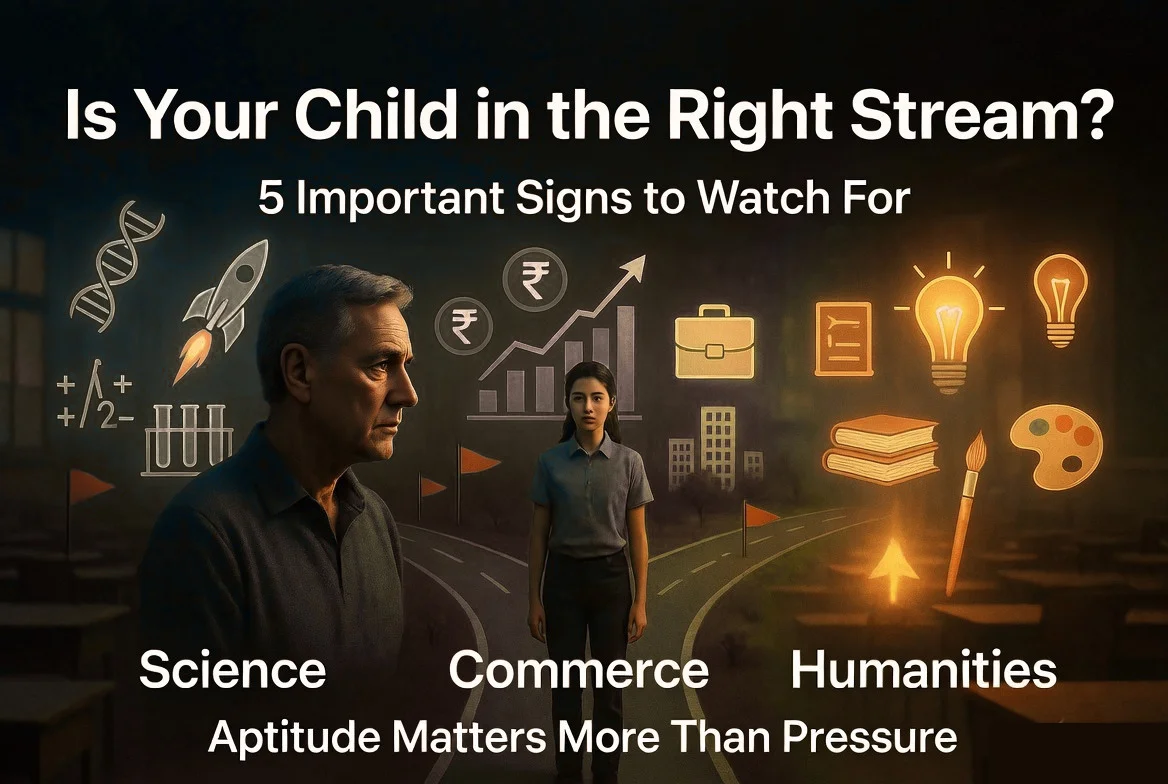
The most reliable child wrong stream signs include a consistent drop in academic performance despite genuine effort, growing disinterest in core subjects, physical symptoms of stress like insomnia or headaches, envy toward peers in other streams, and a complete inability to connect current studies to any future career goal. If your child shows two or more of these signs, it is likely a stream-fit issue — not a talent or discipline problem. Early identification and a data-backed course correction can save years of frustration and set your child on a path that genuinely matches their natural aptitudes.
- Roughly 60% of Indian students choose their stream based on parental pressure or peer influence, not aptitude — leading to preventable academic struggles.
- Falling grades alone don’t confirm a wrong stream; look for a cluster of emotional, behavioural, and academic signs together.
- Stream switches are possible — and far less disruptive than most families assume — especially if done before Class XII board registration deadlines.
- A validated psychometric assessment measuring aptitudes and personality traits is the most objective way to confirm whether the current stream is a genuine mismatch.
Why Asking “Is My Child in the Right Stream?” Is More Important Than Ever in 2026
India’s education system offers three primary streams after Class X — Science (PCM or PCB), Commerce, and Humanities (Arts). The decision is usually made in a few hurried weeks between board results and admission deadlines, often shaped more by family expectations, societal prestige, or a neighbour’s anecdote than by any objective understanding of the child’s natural strengths. A 2024 survey by the Indian Council for Research in Education found that nearly 3 in 5 Class XI students felt they had little real agency in their stream choice. By 2026, with NEP 2020’s flexible pathways still unevenly implemented across CBSE, ICSE, and State boards, the problem persists.
The consequences of a mismatched stream are measurable: higher dropout rates, underperformance in competitive exams like JEE, NEET, or CA Foundation, chronic stress, and — most damaging of all — a young adult who enters college or the workforce with no genuine connection to their field. If you’ve ever wondered “is my child in the right stream,” the five signs below will help you move from worry to clarity.
Sign 1 — Consistent Grade Decline Despite Real Effort (Not Laziness)
Every student has a rough exam cycle now and then. What signals a genuine stream mismatch is a pattern: your child studies for hours, takes tuitions, completes assignments — yet their marks in core stream subjects keep falling or stagnating. A student in PCM who scores well in English and Physical Education but cannot cross 50% in Physics and Mathematics after sustained effort is exhibiting one of the clearest child wrong stream signs.
How to Distinguish Effort-Based Struggle from Laziness
Check the inputs, not just the outputs. Is your child sitting at the desk for two hours or genuinely engaging with the material? Are they asking doubts in class or silently zoning out? If the effort is real but the results aren’t coming — especially in the foundational subjects of their stream (Accounts and Economics for Commerce; Physics and Maths for PCM; Biology and Chemistry for PCB) — the issue is likely aptitude mismatch, not attitude. This is particularly common in stream performance struggles India sees every year among Class XI students suddenly confronting a massive difficulty jump from Class X.
Sign 2 — Emotional and Physical Symptoms of Chronic Stress
Adolescent stress is normal during board years. What is not normal is a child who was previously cheerful and curious becoming persistently anxious, irritable, or withdrawn specifically around academics. Watch for these physical manifestations: frequent headaches before school, disrupted sleep (sleeping too much or too little), appetite changes, and — in serious cases — statements like “I just can’t do this anymore” or “What’s the point?”
Parents often attribute this to “exam pressure” and respond by adding more tuition classes, which can actually worsen the problem if the root cause is a stream mismatch. A child who is naturally high in verbal and linguistic aptitude but is forced into PCM will feel like they’re running uphill in sand — no amount of coaching fixes the underlying friction. If your child’s stress seems disproportionate to their workload, and they were generally fine academically in Class IX and X, the stream itself deserves scrutiny.
Sign 3 — Your Child Shows More Enthusiasm for Subjects Outside Their Stream
This is one of the most telling yet most ignored child wrong stream signs. The Commerce student who spends weekends sketching character designs. The PCB student who lights up during Economics discussions but dreads Biology lab. The Humanities student who voluntarily solves puzzles and logic problems but has no interest in writing essays for Political Science.
Interest vs. Aptitude: Why Both Matter
Interest alone is not sufficient — a child can enjoy watching cricket without having the spatial awareness or reflexes to play at a competitive level. But when interest and aptitude align in a direction that is different from the chosen stream, you have strong evidence of mismatch. In the Indian context, parents sometimes dismiss these signals: “She likes drawing, but that’s a hobby, not a career.” In 2026, with India’s design, UX, animation, and digital media industries valued at over ₹40,000 crore collectively, that dismissal is factually outdated. Aptitude-driven career paths in fields like industrial design (average starting salary ₹6–8 LPA from top institutes), data analytics, journalism, or architecture are viable and growing.
Sign 4 — Your Child Cannot Articulate Any Career Goal Connected to Their Stream
Ask your Class XI or XII child a simple question: “What career do you see yourself working toward with this stream?” If the answer is a blank stare, a vague “engineering, I guess,” or — most revealingly — a career that doesn’t even require their current stream, that’s a red flag. A child in PCB who says they want to be a lawyer, or a Commerce student who dreams of becoming a wildlife biologist, is carrying a daily cognitive dissonance that erodes motivation.
This is not about having a perfectly mapped-out 10-year plan at age 16. It is about having at least a general sense that today’s studies are building toward something personally meaningful. Without that connection, every chapter feels like arbitrary information to be memorised and forgotten after the exam. This is a core reason behind stream performance struggles India witnesses in Class XII boards and entrance exams — students who have no intrinsic motivation to master the material.
What If Your Child Has No Career Goal at All?
That’s actually more common — and more fixable — than you might think. A validated psychometric assessment can surface aptitude patterns the child may not even be consciously aware of. For example, a student who scores high in Numerical and Abstract aptitudes but low in Mechanical aptitude might thrive in actuarial science or financial modelling rather than mechanical engineering — a distinction they’d never discover through school counselling alone.
Sign 5 — They’ve Explicitly Told You They Want to Switch (And You Talked Them Out of It)
This is the most obvious sign and, paradoxically, the most frequently overridden by parents. If your child has directly said — even once — “I don’t think Science is for me” or “I wish I had taken Commerce,” that statement deserves serious investigation, not a motivational speech about how “it gets easier” or “everyone struggles in Class XI.”
Research in educational psychology consistently shows that adolescents who verbalise academic distress are usually understating it, not exaggerating. By the time a 16-year-old musters the courage to challenge a decision that their parents, relatives, and teachers endorsed, they’ve likely been struggling internally for months. Dismissing this as laziness or weakness is one of the most damaging responses a parent can give.
Can You Actually Switch Streams in India?
Yes. Most CBSE and ICSE schools allow stream changes up to a certain deadline in Class XI, typically within the first one to three months. Some schools permit changes between Class XI and XII with conditions. Even if the current school doesn’t allow it, lateral transfers to other schools are possible. The academic cost of switching mid-Class-XI is vastly lower than the cost of completing Class XII in a mismatched stream, scoring poorly in entrance exams, and then spending a “drop year” — or worse, entering a college programme that leads to a career the student never wanted.
What Should You Do If You Spot These Signs?
First, have an honest, non-judgmental conversation with your child. Use open-ended questions: “What subjects feel easiest to you?” “If you could study anything without worrying about careers or money, what would it be?” “What parts of school feel like a waste of your time?” Listen more than you speak.
Second, get objective data. Parental intuition matters, but it’s coloured by your own experiences, aspirations, and biases. A psychometric assessment that measures actual cognitive aptitudes — not just interest surveys — can give you an empirical answer to whether the current stream aligns with your child’s natural strengths. This is especially important in high-stakes scenarios where a JEE or NEET preparation is underway and lakhs of rupees in coaching fees are at risk.
Third, consult your school counsellor — but supplement that conversation with external expertise. School counsellors in India are often overburdened (one counsellor for 800+ students is the norm) and may default to generic advice. An independent, data-backed career guidance session provides the depth that a 15-minute school meeting cannot.
The Career Ka Doctor Approach to Parent Guides
Career Ka Doctor was built to answer exactly the question this article addresses: “Is my child in the right stream?” Instead of relying on guesswork, family tradition, or a single conversation with a school teacher, the Career Ka Doctor approach starts with a validated psychometric assessment that measures 7 distinct aptitude types — Abstract, Numerical, Verbal, Operational, Mechanical, Linguistic, and Spatial — alongside 28 personality traits. This combination captures both what your child can do naturally and how they prefer to work, learn, and interact.
The result is a personalised 60+ page report that doesn’t just list careers but ranks 3 specific career recommendations by natural fit using a proprietary metric called the Effort Index. The Effort Index quantifies how much cognitive effort a particular career path would demand relative to your child’s aptitude profile — a low Effort Index means the career aligns with natural strengths, while a high one signals an uphill battle. This is the same assessment trusted by 23+ schools across India and the Middle East, used as part of institutional career guidance programmes.
If you’re noticing the child wrong stream signs discussed in this article, the most productive next step is to get data before making any decisions. You can learn more about how the assessment works, understand the Effort Index in detail, or simply book a free consultation to discuss your child’s specific situation with a trained career counsellor.
Career Ka Doctor’s complete assessment — 60+ page report + expert counselling session —
gives you data, not guesswork. Book a free consultation on WhatsApp today:
Frequently Asked Questions
What are the most common child wrong stream signs in Class XI?
The most common signs are a consistent drop in core subject marks despite genuine study effort, chronic stress or anxiety around academics, visible enthusiasm for subjects outside the chosen stream, inability to connect current studies to any future career, and direct verbal requests to switch. If two or more of these are present simultaneously, it strongly suggests a stream mismatch rather than a temporary academic slump.
Can my child switch from Science to Commerce after Class XI in CBSE 2026?
Yes, CBSE schools generally allow stream changes between Class XI and XII, though policies vary by school. Most schools have a deadline within the first 1–3 months of Class XI for easy switches. If your child has completed Class XI, a switch is still often possible before Class XII registration closes — you’ll need to speak with your school principal and may need to clear supplementary assessments in the new stream’s Class XI syllabus. A lateral transfer to another school is also an option if your current school is inflexible.
How do I know if my child’s poor marks are due to wrong stream or just difficulty adjusting?
The Class X to XI transition is genuinely tough, and most students see a 10–15% dip in the first term. The key distinction is duration and pattern. If marks recover by the second term with normal effort, it’s adjustment. If they stagnate or decline further despite tuitions and extra study, especially in foundational stream subjects (Physics/Maths for PCM, Biology/Chemistry for PCB, Accounts/Economics for Commerce), the issue is likely aptitude-based. A psychometric assessment can confirm this objectively.
Is my child in the right stream if they score well but hate studying?
Not necessarily. A child with high cognitive ability can score decently in any stream through sheer intelligence, but if they actively dislike the subjects, long-term outcomes suffer. They’ll struggle with competitive exams that require deep engagement (JEE Advanced, NEET UG), lose motivation in college, and may end up in a career they resent. Marks alone don’t confirm stream fit — engagement, curiosity, and a sense of purpose in the subject matter are equally important indicators.
What is the Effort Index in career counselling?
The Effort Index is a metric used by Career Ka Doctor that quantifies how much cognitive effort a specific career path demands relative to a student’s natural aptitude profile. A low Effort Index means the career aligns well with the student’s strengths — they’ll learn faster, perform better, and experience less burnout. A high Effort Index means the career requires aptitudes where the student is naturally weaker, meaning they’ll need significantly more effort to achieve the same results as a better-matched peer.
My child chose PCB for NEET but is struggling — should I let them drop the medical dream?
This is one of the most emotionally charged stream decisions Indian families face. Before making any change, get objective aptitude data. If your child’s Numerical, Spatial, and Abstract aptitudes are low while Verbal and Linguistic aptitudes