
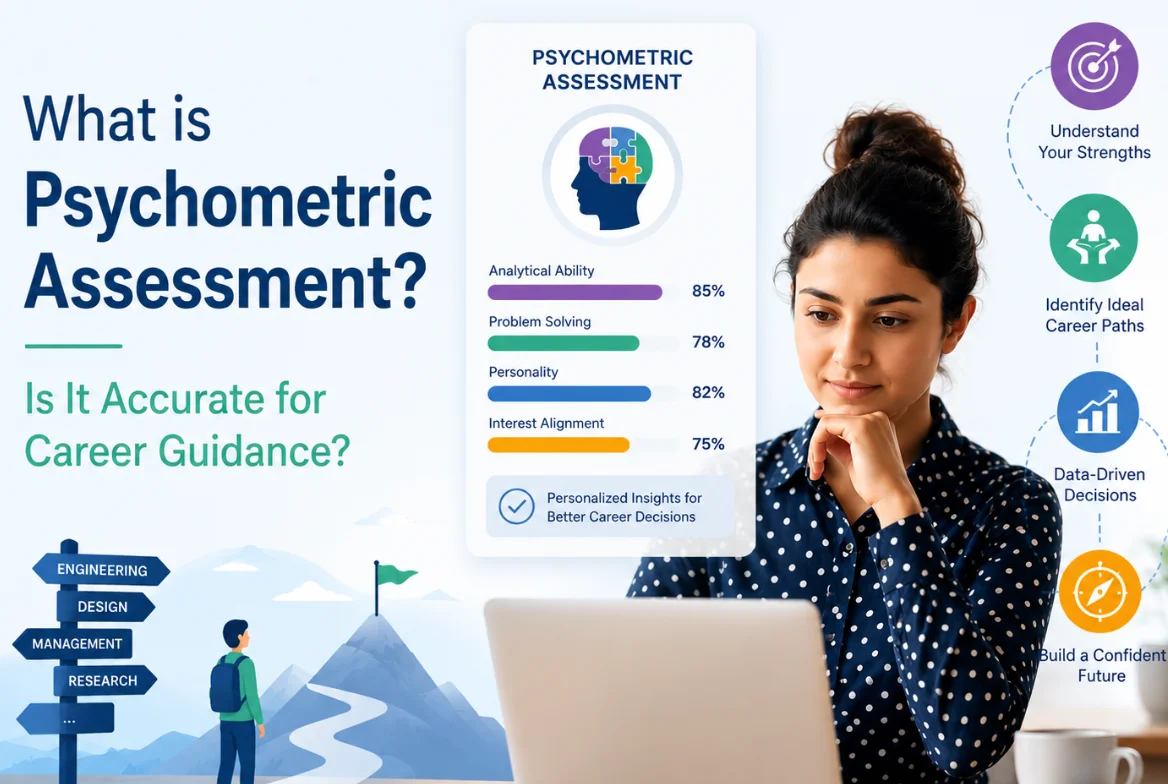
A psychometric assessment is a standardised, science-backed evaluation that measures a student’s natural aptitudes, personality traits, and cognitive abilities to predict which careers they will find easiest and most fulfilling. Psychometric assessment in India has grown rapidly as a reliable alternative to guesswork-based career decisions, and when the test is validated (meaning it has been statistically proven to measure what it claims), research shows it can predict career fit with significant accuracy — far better than choosing a stream based solely on marks, family pressure, or peer trends.
- A psychometric assessment measures innate aptitudes and personality traits — not just knowledge or academic performance.
- Validated psychometric tests used for career guidance typically show test–retest reliability of 0.70–0.90, meaning results are highly consistent over time.
- For Indian students in Classes IX–XII, a career psychometric test can objectively guide stream selection (PCM/PCB/Commerce/Arts) and competitive exam choices (JEE/NEET/CA/CLAT).
- Accuracy depends on whether the test is validated, normed for Indian populations, and interpreted by a trained counsellor — not all online quizzes qualify.
What Is a Psychometric Assessment? Understanding the Basics
The word “psychometric” comes from the Greek words psyche (mind) and metron (measurement). A psychometric assessment is essentially a structured measurement of the mind — specifically, how a person thinks, processes information, solves problems, and behaves in different situations. Unlike school exams that test what you have memorised, a psychometric test measures how your brain works naturally.
There are two main components in any comprehensive career psychometric test. The first is aptitude testing, which measures your raw cognitive abilities — such as how easily you work with numbers, recognise spatial patterns, understand mechanical systems, or process verbal and abstract information. The second is personality profiling, which maps your behavioural tendencies — whether you are detail-oriented or big-picture-focused, introverted or extroverted, risk-tolerant or risk-averse, and so on. When these two dimensions are combined, you get a remarkably detailed picture of which careers a student would naturally excel in and, equally importantly, which careers would drain them.
How Is It Different from a Career Quiz?
Free online career quizzes typically ask 10–20 opinion-based questions such as “Do you like science?” and produce vague results like “You should be a scientist.” These quizzes have no statistical validation, no reliability data, and no standardised norms. A genuine psychometric assessment, by contrast, involves 100–300+ items, is timed (for aptitude sections), has been tested on thousands of students to establish norms, and produces results that are statistically meaningful. The difference is roughly equivalent to the difference between checking WebMD symptoms and getting a proper diagnostic test at a hospital.
The Science Behind Psychometric Assessment in India
Psychometric assessment in India draws on over a century of psychological research. The foundational theory comes from differential psychology — the study of how and why individuals differ from one another in cognitive abilities and personality. Key frameworks used in modern career psychometric testing include Thurstone’s Primary Mental Abilities model (which identified distinct aptitude types like verbal comprehension, numerical facility, and spatial visualisation), the Big Five personality model (Openness, Conscientiousness, Extraversion, Agreeableness, Neuroticism), and Holland’s RIASEC theory of vocational interests.
What makes a psychometric assessment scientifically credible are two properties: reliability and validity. Reliability means the test gives consistent results — if a student takes it today and again two months later, the scores should be highly correlated. Validity means the test actually measures what it claims to measure. A well-constructed career psychometric test will have published reliability coefficients (typically 0.70 or higher is considered good) and evidence that its scores genuinely correlate with career satisfaction and academic performance in specific fields.
Why Indian Norms Matter
A critical factor many parents overlook is whether the psychometric assessment has been normed for Indian students. A test developed and normed entirely on American or European populations may not account for the Indian education system’s unique features — the emphasis on rote learning in many CBSE and State board schools, the specific competitive exam culture around JEE and NEET, or the different socio-economic contexts that shape career availability. The best psychometric assessments used in India either have Indian norms or have been specifically calibrated for Indian student populations.
Is Psychometric Test Accurate? What the Research Says
The question “is psychometric test accurate” is the most common concern parents raise — and it deserves a straight answer. No test is 100% accurate. However, validated psychometric assessments are significantly more accurate than any alternative method currently available for predicting career fit. Meta-analyses published in journals like the Journal of Applied Psychology show that cognitive aptitude tests predict job performance with a validity coefficient of approximately 0.50–0.65, which is stronger than structured interviews (0.51), years of job experience (0.18), or educational grades alone (0.30–0.35).
For Indian students, this has a very practical implication. Suppose a Class X student scores exceptionally high in Abstract and Numerical aptitude but low in Verbal and Linguistic aptitude. A validated assessment would steer them towards careers in engineering, data science, or quantitative finance rather than law or journalism. This is not a guarantee of success — hard work, opportunities, and personal motivation all matter — but it tells you where the student’s natural grain lies. Working with natural aptitude means less effort for the same result, whereas working against it means constant struggle for mediocre outcomes.
What Reduces Accuracy?
Psychometric assessment accuracy drops significantly when: (a) the test is not validated or has poor psychometric properties, (b) the student does not take it seriously (rushing through, clicking random answers), (c) the results are interpreted without context by an untrained person, or (d) the test only measures one dimension (e.g., only personality, ignoring aptitude). This is why choosing the right assessment and the right counsellor is just as important as deciding to take a test in the first place.
How Career Psychometric Tests Help Indian Students Choose the Right Stream
Indian students face a uniquely high-stakes decision at the end of Class X: choosing between PCM, PCB, Commerce, Arts, or hybrid combinations. This decision effectively narrows their career options for the next several decades. Yet most students make this choice based on three deeply unreliable signals — their percentage in Class X board exams, what their friends are choosing, or what their parents or relatives recommend. None of these correlate meaningfully with long-term career satisfaction.
A career psychometric test introduces objectivity into this process. For example, consider a student who scored 92% in Class X CBSE boards and is being pushed towards PCM and JEE coaching. If a validated assessment reveals that this student has high Verbal and Linguistic aptitude, strong Conscientiousness and Agreeableness traits, but only average Numerical and Spatial aptitude, the data would suggest careers in law (CLAT preparation), psychology, public policy, or management rather than engineering. The 92% was achieved through hard work and memorisation — but hard work cannot substitute for natural aptitude over a 40-year career.
Real Career Mapping: Beyond “Science or Commerce”
One of the most valuable features of a good career psychometric test is that it does not simply say “take Science.” It maps specific career paths. Instead of a binary Science/Commerce recommendation, a well-designed assessment might tell a student: “Your aptitude profile is strongest for Biotechnology Research, Clinical Psychology, or Health Informatics — and here is why, based on your specific combination of Numerical, Verbal, and Abstract reasoning scores and your personality traits.” This level of specificity is what separates validated psychometric assessments from generic aptitude tests that produce one-word labels.
Common Myths About Psychometric Assessment in India
Myth 1: “My child is too young for a psychometric test.” Students as young as Class IX (age 13–14) can take validated aptitude and personality assessments. In fact, this is the ideal time — before stream selection locks them into a path. Aptitudes stabilise significantly by age 14, making the results meaningful and actionable.
Myth 2: “Psychometric tests box you into one career.” A good assessment provides a range of career options, ranked by fit, not a single rigid prescription. It expands choices by revealing careers the student may never have considered. For instance, a student high in Mechanical and Spatial aptitude might be shown careers not only in mechanical engineering but also in industrial design, architecture, prosthetics development, or robotics.
Myth 3: “These tests are just like personality quizzes on social media.” Validated psychometric assessments undergo years of development, pilot testing, item analysis, and norm calibration. They are reviewed for cultural bias, gender bias, and statistical robustness. Comparing them to a “Which Hogwarts House Are You?” quiz is like comparing an MRI scan to a horoscope.
Myth 4: “Board exam marks are enough to decide a career.” Board exam marks measure academic knowledge at a point in time. They do not measure aptitude for spatial reasoning, mechanical thinking, leadership orientation, risk tolerance, creativity, or dozens of other traits that determine whether someone will thrive in a specific career. A student can score 95% in Physics and still be miserable as a physicist if their personality craves human interaction and variety rather than solitary research.
The Career Ka Doctor Approach to Career Guidance
Career Ka Doctor uses a validated psychometric assessment specifically designed for Indian students in Classes IX–XII. The assessment measures 7 distinct aptitude types — Abstract, Numerical, Verbal, Operational, Mechanical, Linguistic, and Spatial — alongside 28 personality traits covering dimensions like analytical thinking, social confidence, resilience, and creative orientation. This dual-axis measurement ensures that career recommendations account for both what a student can do and what they will enjoy doing.
The output is a personalised 60+ page report that includes detailed aptitude and personality profiles, followed by 3 specific career recommendations ranked by natural fit. The ranking is determined by the Effort Index — a proprietary metric that quantifies how much effort a student would need to succeed in each career relative to their natural abilities. A low Effort Index means the career aligns closely with the student’s innate strengths; a high Effort Index signals a mismatch that would require significantly more energy to overcome. This gives families a concrete, data-driven framework for decision-making rather than vague advice.
Currently used by 23+ schools across India and the Middle East, Career Ka Doctor’s assessment is followed by an expert counselling session where a trained career counsellor walks the family through the report, answers questions, and helps translate the data into actionable next steps — whether that means choosing a stream, selecting elective subjects, deciding on competitive exams, or exploring unconventional career paths. You can learn more about how the assessment works or book a free consultation to understand if it is the right fit for your child.
Career Ka Doctor’s complete assessment — 60+ page report + expert counselling session —
gives you data, not guesswork. Book a free consultation on WhatsApp today:
Frequently Asked Questions
Is psychometric assessment accurate for career guidance in India?
Yes, when the assessment is validated and normed appropriately. Research shows that validated psychometric tests predict career fit with a validity coefficient of 0.50–0.65, which is significantly stronger than using academic marks alone (0.30–0.35). Accuracy improves further when results are interpreted by a trained counsellor who understands the Indian education system and career landscape.
What is the best age for a student to take a career psychometric test?
The ideal window is Class IX or early Class X — typically between ages 13 and 15. At this stage, aptitudes have stabilised enough to produce reliable measurements, and the student still has time to make informed stream and subject choices before the Class X board exams. Taking the test after stream selection (in Class XI or XII) is still useful but limits the range of actionable decisions.
Can a psychometric test tell me if my child should prepare for JEE or NEET in 2026?
A psychometric test does not directly say “take JEE” or “take NEET,” but it reveals the aptitude and personality profile that predicts success in engineering versus medical versus other fields. For example, high Spatial and Abstract aptitude combined with strong Mechanical reasoning suggests engineering aptitude, while high Verbal reasoning, Conscientiousness, and Operational aptitude may point towards medicine. A counsellor then translates these findings into specific exam and preparation recommendations for 2026 and beyond.
How is a psychometric assessment different from an IQ test?
An IQ test produces a single general intelligence score. A career-focused psychometric assessment breaks cognitive ability into multiple distinct aptitudes (e.g., Numerical, Verbal, Spatial, Abstract, Mechanical) and also measures personality traits. This multi-dimensional approach is far more useful for career guidance because two students with the same IQ can have very different aptitude profiles and, therefore, very different ideal career paths.
Are online psychometric tests reliable, or should I take one offline?
The delivery method (online vs. offline) matters less than the quality of the test itself. A validated psychometric assessment administered online under proper conditions (timed, proctored or monitored, with clear instructions) is just as reliable as a paper-based version. What you should check is whether the assessment has published reliability and validity data, whether it measures both aptitude and personality, and whether results are interpreted by a qualified counsellor — not auto-generated by an algorithm alone.
How much does a psychometric assessment cost in India?
Costs vary widely. Free online quizzes are available but lack validation and depth. Professional career psychometric tests in India typically range from ₹1,500 to ₹8,000, depending on the comprehensiveness of the assessment, the detail of the report, and whether expert counselling is included. Considering that the wrong stream choice can lead to years of wasted coaching fees, college tuition, and career dissatisf