
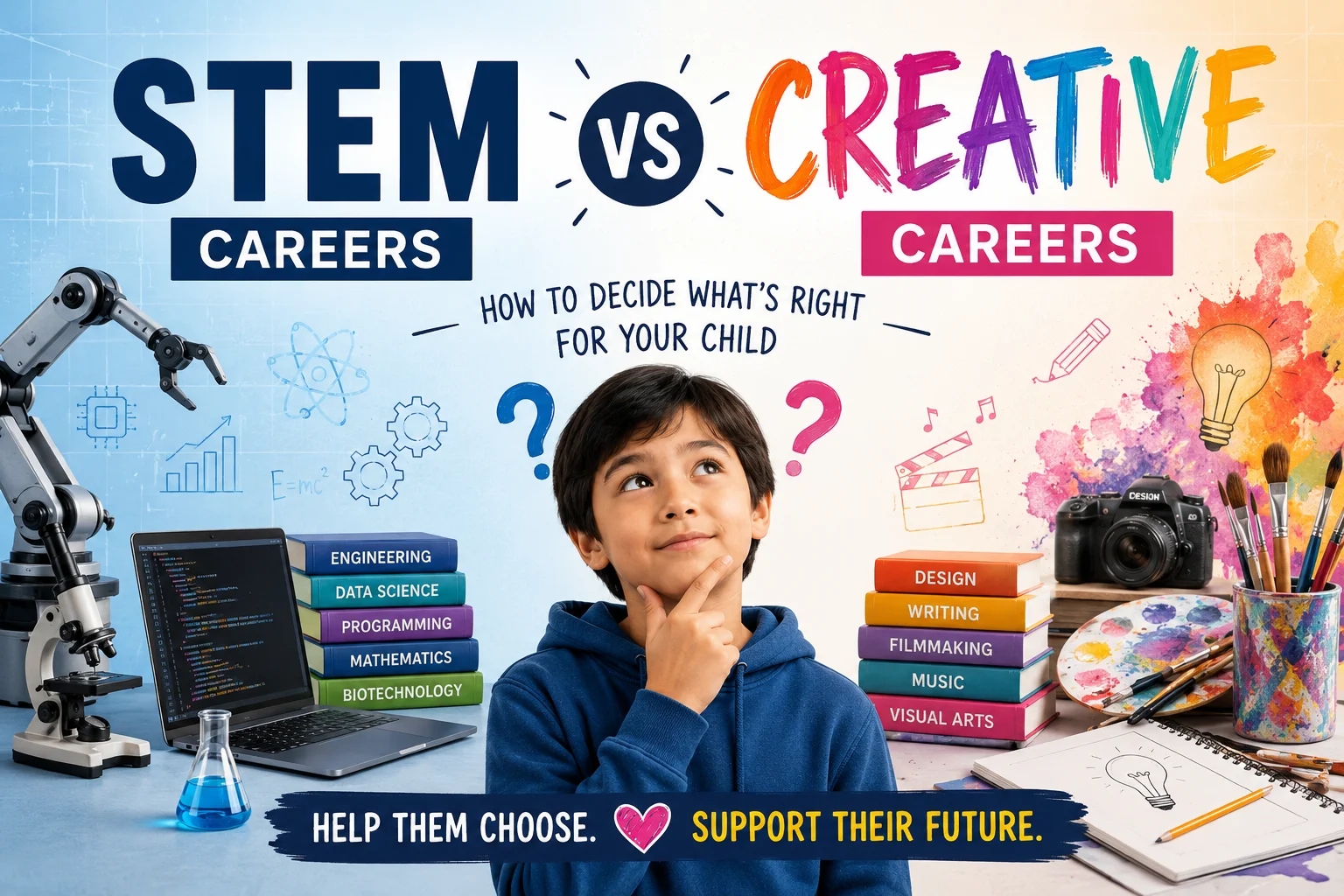
The STEM vs creative careers India debate isn’t about which path is “better” — it’s about which path naturally fits your child’s aptitude profile and personality traits. A student with high spatial and abstract reasoning may thrive in architecture or UX design (which blends both STEM and creativity), while a student with strong numerical and operational aptitudes may excel in data science or financial engineering. The right decision requires measuring your child’s innate strengths with a validated psychometric assessment, not following family pressure or market trends.
- STEM and creative careers are no longer mutually exclusive — fields like game design, biomedical illustration, and computational linguistics sit at the intersection of both.
- A child’s aptitude type (Abstract, Numerical, Verbal, Spatial, Mechanical, Linguistic, Operational) is a far better predictor of career success than Class X board marks or entrance exam ranks.
- In India’s 2026 job market, creative professionals in UI/UX, content strategy, and animation earn ₹8–25 LPA — comparable to many traditional STEM roles.
- Forcing a high-verbal, high-linguistic child into PCM just because “science has more scope” leads to higher dropout rates, burnout, and career dissatisfaction within 5 years.
Why the STEM vs Creative Careers India Debate Is Outdated
For decades, Indian families have treated career decisions as a binary: either your child takes PCM/PCB and pursues engineering or medicine, or they “settle” for arts and humanities. This science vs arts career India mentality was shaped by a time when creative careers genuinely offered fewer stable opportunities. A fine arts graduate in 1995 had limited options — teaching, advertising, or freelancing with unpredictable income.
But in 2026, that landscape has fundamentally shifted. India’s creative economy — spanning digital media, gaming, OTT content production, design thinking, and brand strategy — is projected to be worth over $30 billion. Meanwhile, STEM fields themselves increasingly demand creative thinking: AI prompt engineering requires linguistic aptitude, product management needs strong verbal and abstract reasoning, and robotics engineers benefit enormously from spatial intelligence. The old binary doesn’t serve your child. What serves them is understanding their unique aptitude and personality profile.
The Real Problem: Stream Selection Happens Too Early Without Data
In most CBSE and ICSE schools, students choose between PCM, PCB, Commerce, and Arts at the end of Class X — typically at age 15 or 16. This decision is usually driven by three factors: board exam percentage (above 90% = PCM, below 80% = Arts), parental preference, and peer influence. None of these factors measure the child’s natural aptitudes. A student scoring 95% in Class X may have achieved it through intense coaching, not because they possess the abstract and numerical reasoning that engineering or pure sciences demand over 4+ years.
What Aptitude Data Reveals About STEM vs Creative Career Choice
When we talk about aptitude in the context of stem creative career choice, we’re referring to innate cognitive strengths — not learned skills or exam scores. There are 7 measurable aptitude types that directly influence which career paths feel natural versus exhausting for a student:
Abstract Reasoning — the ability to identify patterns and solve novel problems. Critical for pure sciences, research, software development, and strategic design. Numerical Aptitude — comfort with quantitative data, essential for engineering, actuarial science, economics, and data analytics. Verbal Aptitude — strength in understanding and communicating complex ideas through language, vital for law, journalism, content strategy, and psychology. Spatial Aptitude — the ability to visualise and manipulate 3D objects mentally, crucial for architecture, industrial design, surgery, and animation. Mechanical Aptitude — understanding of physical systems and how things work, relevant for mechanical engineering, automotive design, and robotics. Linguistic Aptitude — sensitivity to language structure, tone, and nuance, important for translation, copywriting, foreign language careers, and computational linguistics. Operational Aptitude — efficiency in executing systematic, process-oriented tasks, valuable for project management, accounting, supply chain management, and quality assurance.
Why a High Spatial + High Verbal Student Shouldn’t Be Forced Into Pure STEM
Consider a real scenario: a Class X student scores well in mathematics but their psychometric profile reveals high spatial aptitude, high verbal aptitude, and moderate numerical aptitude. Their personality traits show high openness, high aesthetic sensitivity, and moderate conscientiousness. This student’s parents want them to take PCM and target IIT through JEE. But their natural fit points toward architecture (which uses spatial + numerical), UX research (verbal + spatial), or even filmmaking (spatial + verbal + linguistic). Forcing them into competitive JEE preparation when their numerical aptitude is only moderate means they’ll expend disproportionate effort for mediocre results — what Career Ka Doctor measures as a high Effort Index.
STEM Careers That Require Creative Aptitudes (and Vice Versa)
One of the biggest misconceptions in the science vs arts career India conversation is that STEM careers are purely analytical and creative careers are purely artistic. In reality, many of the most rewarding and high-paying career paths in 2026 sit at the intersection. Here are concrete examples:
STEM Roles That Demand Creative Thinking
Biomedical Engineering: Requires mechanical and spatial aptitude combined with innovative problem-solving — designing prosthetics, surgical tools, and wearable health devices. Starting salaries in India: ₹6–12 LPA. Data Visualisation Specialist: Combines numerical aptitude with spatial and aesthetic sensibility to translate complex datasets into visual stories. Companies like Flipkart, Swiggy, and Razorpay actively hire for this role at ₹10–18 LPA. Computational Linguist: Builds natural language processing models for AI systems — demands both linguistic aptitude and abstract reasoning. This is one of the fastest-growing roles in India’s AI ecosystem.
Creative Roles That Demand Analytical Rigour
Game Designer: Uses spatial reasoning, numerical balancing (game economics), and storytelling ability. India’s gaming industry crossed $3.5 billion in 2025 and continues to grow. User Experience Researcher: Applies experimental design, statistical analysis, and verbal communication to study user behaviour. Requires a blend of STEM methodology and human-centred design. Architect: Needs spatial aptitude, mathematical precision, structural engineering knowledge, and deep aesthetic sensitivity. Architects in top Indian firms earn ₹12–30 LPA with 5–8 years of experience.
The Personality Factor: Why Aptitude Alone Isn’t Enough
Aptitude tells you what your child can do well. Personality tells you what they’ll want to do consistently over a 30-year career. This distinction is critical in the STEM vs creative careers India discussion. Two students can have identical aptitude profiles but wildly different personality traits — and they’ll thrive in completely different environments.
For instance, a student with high numerical and abstract aptitude plus high introversion, high independence, and low social orientation is a natural fit for research science or quantitative analysis — roles with deep solo work. The same aptitude profile paired with high extroversion, high persuasion, and high leadership orientation points toward management consulting, fintech entrepreneurship, or science communication. There are 28 distinct personality traits that shape career satisfaction, including risk tolerance, persistence, detail orientation, empathy, competitiveness, and aesthetic sensitivity. Ignoring personality when making a stem creative career choice is like buying shoes based only on size without checking width — technically they fit, but they’ll cause pain over time.
What Happens When Personality and Stream Don’t Match
Research consistently shows that students whose chosen stream conflicts with their personality profile are 2–3 times more likely to switch careers within the first five years after graduating. In the Indian context, this means a student who completed B.Tech from a decent college but had low mechanical aptitude and high linguistic aptitude may end up pivoting to content marketing, copywriting, or journalism — effectively “wasting” four years and ₹8–15 lakh on a degree they never use. Early assessment prevents this costly misalignment.
How Indian Parents Can Move Beyond the Science vs Arts Binary in 2026
If you’re a parent of a student in Class IX or X, here’s a practical framework to approach the STEM vs creative careers India question without falling into outdated thinking:
Step 1: Get an objective aptitude and personality assessment done before stream selection. This should be a validated psychometric assessment, not an online quiz or a teacher’s subjective opinion. Look for assessments that measure multiple aptitude dimensions — not just “logical” vs “creative” — because real careers require combinations of aptitudes. Step 2: Map your child’s profile against actual career paths, not just degree programmes. “B.Tech in Computer Science” is not a career — it’s a degree. The career could be software engineering, AI research, product design, cybersecurity, or tech journalism, each requiring different aptitude-personality combinations. Step 3: Calculate the Effort Index. For each potential career path, assess how much effort your child would need to expend to succeed, given their natural aptitude profile. A lower Effort Index means the career leverages their strengths; a higher one means they’ll be constantly fighting against their natural grain.
Step 4: Have an honest family conversation about values, lifestyle, and financial expectations. A career in documentary filmmaking may perfectly match your child’s aptitudes but may involve 3–5 years of lower income before stability. A career in chartered accountancy may offer earlier financial stability but could feel suffocating for a child with high openness and low operational aptitude. Both paths are valid — the key is informed choice, not reactive decisions made under board exam pressure.
The Career Ka Doctor Approach to Career Guidance
Career Ka Doctor addresses the STEM vs creative careers India dilemma with a science-backed methodology designed specifically for Indian students in Classes IX–XII. The process begins with a validated psychometric assessment that measures 7 distinct aptitude types — Abstract, Numerical, Verbal, Operational, Mechanical, Linguistic, and Spatial — along with 28 personality traits. Unlike surface-level aptitude quizzes, this assessment generates a personalised 60+ page report that goes deep into your child’s cognitive and personality profile.
What makes the approach unique is the Effort Index — a proprietary metric that ranks career paths by how naturally they align with your child’s profile. Instead of giving a generic list of “suitable careers,” Career Ka Doctor delivers 3 specific career recommendations ranked by natural fit. A lower Effort Index means your child can achieve career success by leveraging their innate strengths rather than compensating for weaknesses. The assessment and counselling framework is currently used by 23+ schools across India and the Middle East, serving thousands of students who need clarity before making stream and career decisions. You can learn more about how the assessment works or book a free consultation to discuss your child’s specific situation with an expert counsellor.
Career Ka Doctor’s complete assessment — 60+ page report + expert counselling session —
gives you data, not guesswork. Book a free consultation on WhatsApp today:
Frequently Asked Questions
How do I decide between STEM vs creative careers for my child in India?
The best way to decide is by getting a validated psychometric assessment that measures your child’s aptitude types (abstract, numerical, verbal, spatial, mechanical, linguistic, operational) and personality traits. Board exam marks tell you what a child has memorised, not what they’re naturally suited for. Map the assessment results against specific career paths — not just degree programmes — and look at how much effort each path would demand relative to their strengths.
Are creative careers in India well-paying in 2026?
Yes, several creative careers now offer salaries comparable to traditional STEM roles. UX designers earn ₹8–22 LPA, animation professionals at top studios earn ₹10–20 LPA, and brand strategists at leading agencies earn ₹12–25 LPA. India’s creative economy — including gaming, OTT content, digital design, and advertising technology — has grown significantly, creating stable high-paying roles that didn’t exist a decade ago.
My child is good at both science and art — which stream should they choose after Class X?
Students who show strength in both analytical and creative areas are often well-suited for hybrid careers like architecture, biomedical design, UX research, game development, or data visualisation. The stream choice (PCM, PCB, Commerce, or Arts) should align with which aptitude type is stronger and which personality traits dominate. A psychometric assessment can quantify this precisely rather than leaving it to guesswork.
Is choosing arts stream after Class X a bad decision in India?
No — choosing arts is only a bad decision if it doesn’t match the student’s aptitude and personality profile. An arts stream is the right choice for students with high verbal, linguistic, or spatial aptitudes and personality traits like high openness and aesthetic sensitivity. The stigma around arts in India is cultural, not factual. What matters is whether the stream leads to career paths that align with the student’s natural strengths.
What is the Effort Index in career counselling?
The Effort Index is a metric used by Career Ka Doctor that measures how much effort a student would need to invest to succeed in a particular career, based on their aptitude and personality profile. A low Effort Index means the career naturally leverages the student’s strengths — they’ll perform well without constantly struggling. A high Effort Index signals a mismatch where the student would need to work disproportionately hard to achieve average results.
When is the best time to do a career aptitude test for my child — Class IX, X, or XII?
The ideal time is Class IX or early Class X, before stream selection decisions are made. At this stage, the assessment results can directly inform whether your child should choose PCM, PCB, Commerce, or Arts. Testing in Class XI or XII is still valuable for choosing specific degree programmes and career paths, but by then the stream is already locked. Early assessment gives families the maximum time to plan effectively.