Why Most Students Pick a Stream Without Knowing Who They Really Are
Here is a scene that plays out in lakhs of Indian households every year. A student in Class IX or X sits at the dining table, surrounded by well-meaning relatives, and hears some version of this: “You’re good at maths — take PCM.” Or: “You’re a people person — try law.” These suggestions come from love, but they are based on surface-level observations, not a structured understanding of the student’s personality. The result? A student enters Class XI, picks a stream, and within six months feels a quiet but persistent sense of misfit. The real issue is not intelligence or effort. It is a mismatch between the student’s natural personality type and the career path they have been placed on. Understanding your career personality type in India is not a luxury — it is a necessity before you commit to a stream, a college entrance exam, or a professional direction.
What Are Career Personality Profiles and Why Do They Matter?
A personality test for career guidance does something that marks and grades cannot: it reveals how a student naturally thinks, works, interacts, and makes decisions. Two students can both score 90% in their board exams and yet be fundamentally different in how they approach problems, handle people, and manage stress. Career personality profiles give language and structure to these differences. The MapMyTalent psychometric assessment, used by Career Ka Doctor, identifies 8 distinct personality profiles that map onto real career paths. These are not zodiac-style labels. They are research-backed behavioural patterns derived from 28 measured personality traits. When a student understands which profile fits them best, stream selection, subject choices, and even college shortlisting become dramatically clearer.
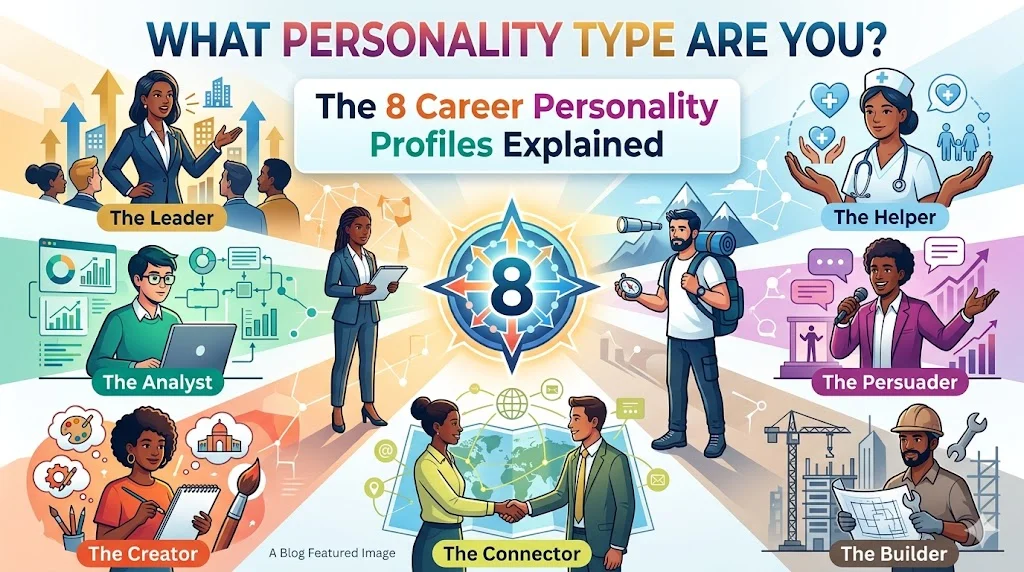
The 8 Career Personality Profiles — Explained Honestly
Let us walk through each of the 8 career personality profiles identified in the MapMyTalent framework. As you read, think about which one sounds most like your child — not who you want them to be, but who they naturally are.
1. Administrator: This student is the one who organises the class trip, keeps a tidy study schedule, and gets genuinely irritated when plans fall apart. Administrators thrive in structured roles — management, civil services, operations, finance, and project leadership. They do not just follow systems; they build and maintain them. If your child is naturally drawn to order and responsibility, this profile is likely a strong fit.
2. Logical: The Logical personality is driven by analysis, reasoning, and problem-solving. These students ask “why” more than “what.” They are often drawn to PCM not because of parental pressure, but because they genuinely enjoy dissecting how things work. Careers in engineering, data science, research, economics, and technology align well. But note — not every Logical student should do engineering. The specific aptitude scores matter just as much.
3. Meticulous: Meticulous students are detail-oriented, precise, and patient. They notice the small errors others miss. They tend to excel in fields requiring accuracy — accounting, pharmacy, quality control, laboratory sciences, editing, and architecture. In the Indian context, these students often get overlooked because their strength is quiet rather than flashy.
4. Artistic: This profile is not limited to painting or music. Artistic personalities are creative thinkers who see possibilities others do not. They may gravitate toward design, advertising, content creation, filmmaking, UX design, or architecture. In a system that often undervalues the Arts stream, these students need validation that their instincts are legitimate and professionally viable.
5. Cool Rock: The Cool Rock personality is calm under pressure, independent, and quietly confident. They do not seek the spotlight but perform exceptionally when given autonomy. Careers in technology, research, aviation, forensic science, and even entrepreneurship suit this profile. These students often resist the herd mentality of “everybody is doing JEE coaching,” and they are usually right to trust that instinct.
6. People’s Person: This student lights up in group settings, builds friendships effortlessly, and feels energised by human interaction. They are natural fits for careers in counselling, human resources, teaching, healthcare, hospitality, and social work. The danger for this profile in the Indian education system is being pushed toward PCM or Commerce when their true strength is in people-facing professions.
7. Socially Smart: Different from the People’s Person, the Socially Smart personality understands social dynamics at a strategic level. They read rooms, negotiate well, and influence outcomes. Think sales leadership, diplomacy, law, politics, public relations, and business development. These students are often labelled “talkative” in school — but that very trait, channelled correctly, becomes a career superpower.
8. Combination Profiles: Most students do not fit neatly into one box, and the MapMyTalent assessment accounts for this. A student might be both Logical and Meticulous — ideal for clinical research or actuarial science. Or Artistic and Socially Smart — perfect for brand management or media. These combination profiles are where the real precision of career guidance lies. A single-label approach often misguides. Combinations tell the true story.
Why Generic Personality Quizzes Fall Short
The internet is flooded with free personality quizzes that promise to reveal your ideal career in five minutes. Most of them are entertainment, not science. They measure self-perception, not actual behavioural traits. A proper personality test for career mapping needs to be normed for the relevant population, validated through research, and interpreted alongside aptitude data — not in isolation. A student who scores high on the Artistic personality profile but has low spatial aptitude, for example, may thrive in creative writing rather than architecture. Without aptitude data, you only have half the picture.
The Career Ka Doctor Approach
Career Ka Doctor uses the MapMyTalent psychometric assessment to measure 7 aptitude types and 28 personality traits in a single, structured evaluation. The outcome is a 20+ page personalised report that does not just name a personality profile — it cross-references personality with aptitude to generate 3 career recommendations ranked by natural fit. The report also includes an Effort Index, which honestly tells the student and parent how much effort a particular career path would require given the student’s current strengths. This is not about labelling a child. It is about giving families real data to make real decisions — before stream selection, before entrance exam coaching investments, and before years are spent on a path that does not fit. The assessment has been used by 23+ schools across India and the Middle East, and it is followed by an expert counselling session where the report is explained in detail — not handed over as a PDF and forgotten.
Final Thoughts
Every student has a natural personality blueprint. The question is whether you discover it at 15, when it can shape smart decisions, or at 25, when it explains years of dissatisfaction. Understanding career personality profiles is not about putting your child in a box — it is about making sure they are not forced into the wrong one. In a country where stream selection in Class X can define the next decade of a student’s life, having science-backed clarity on personality type is one of the most practical investments a parent can make. Know the profile first. Then choose the path.
Career Ka Doctor’s complete assessment — 20+ page report + expert counselling session —
gives you data, not guesswork. Book a free consultation on WhatsApp today: