The Dinner Table Dilemma Every Indian Family Knows Too Well
It usually starts around the time Class X board results are out. Sometimes even earlier. The relatives weigh in, the neighbours share opinions, and somewhere between “beta, engineering is safe” and “doctor bano, respect milta hai,” a 15-year-old is expected to make a decision that shapes the next decade of their life. The engineering vs medicine career debate has been raging in Indian households for generations — and now, with commerce and newer fields surging in relevance, the confusion has only tripled. But here is the uncomfortable truth: most families are making this decision based on trends, societal pressure, or a cousin’s salary package — not on any real understanding of the child’s actual strengths. That is a problem we can fix.
Why the Traditional “Score-Based” Method Fails
In India, we have built an entire culture around a dangerously simple formula: high marks in PCM means engineering, high marks in PCB means medicine, and “if nothing else works,” commerce. This is not career guidance. This is slot-filling. A student who scores 95% in physics may genuinely hate the idea of sitting in front of circuit boards for the next four years. A student with moderate marks in biology might have extraordinary spatial reasoning and empathy — traits that make outstanding surgeons. Marks tell you what a student studied. They do not tell you what a student is naturally built for. And that distinction matters enormously when you are choosing among after 12th career options India offers today, because the landscape is vastly more complex than it was even ten years ago. Engineering alone now branches into over 40 specialisations. Medicine goes well beyond MBBS into public health, biomedical engineering, clinical psychology, and allied health sciences. Commerce opens doors to chartered accountancy, actuarial science, investment banking, data analytics, and entrepreneurship. Choosing a stream without understanding aptitude is like prescribing medicine without running a diagnosis. You might get lucky — or you might cause real damage.
What Actually Differs Between These Three Paths (Beyond the Obvious)
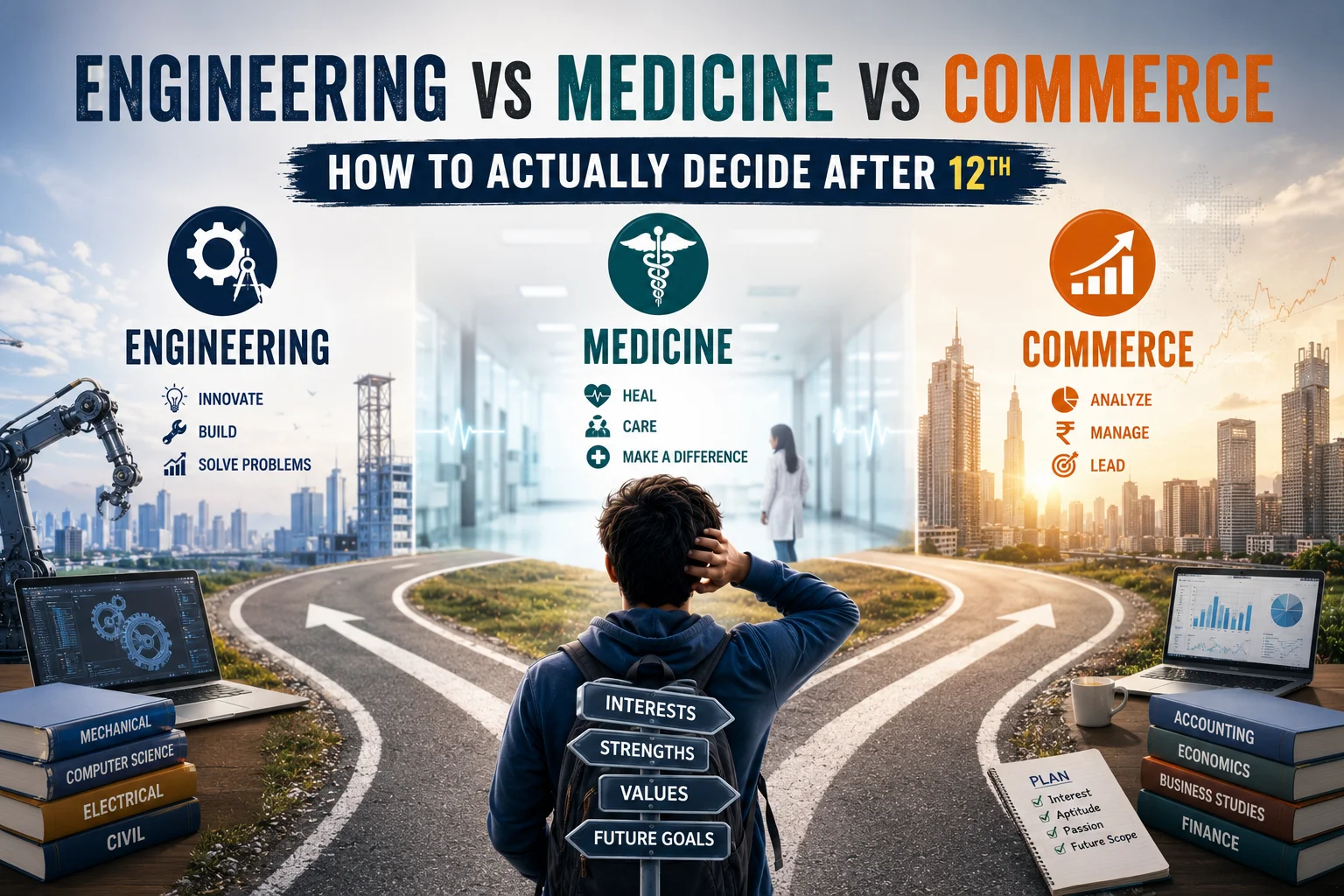
Let us look at what each broad stream genuinely demands from a student — not in terms of syllabus, but in terms of cognitive and personality traits.
Engineering (and related STEM fields): Requires strong numerical reasoning, abstract thinking, spatial visualisation, and a high tolerance for problem-solving under pressure. Students who thrive here tend to enjoy systems, patterns, and building things. They often prefer working with ideas or machines over extensive human interaction.
Medicine (and allied health sciences): Demands exceptional memory, verbal reasoning, scientific aptitude, emotional resilience, and genuine empathy. The journey is long — MBBS alone is five and a half years, followed by years of specialisation. Students who do well here are typically patient, detail-oriented, and deeply motivated by human welfare rather than quick financial returns.
Commerce (and business-related fields): Requires strong numerical ability (though different from engineering-style math), persuasive communication, organisational thinking, and often a knack for understanding human behaviour and economic systems. Students drawn here tend to be pragmatic, socially aware, and interested in how money and markets function.
Notice that none of these descriptions mention board exam percentages. That is because the real differentiators are aptitudes and personality traits — and these can be measured with far more precision than most families realise.
The Data That Should Actually Drive Your Career Decision in 12th Grade
A meaningful career decision after 12th grade should rest on at least three pillars of data. First, aptitude: what type of thinking does the student naturally excel at? Numerical, verbal, spatial, mechanical, clerical, abstract, or social reasoning? Each career cluster leans heavily on specific aptitude combinations. Second, personality: is the student introverted or extroverted? Do they prefer structured environments or creative freedom? Are they risk-takers or stability-seekers? These traits determine not just which career fits, but which specific role within a career field will feel energising rather than draining. Third, effort alignment: even if a student has the aptitude for a field, how much additional effort will it take them to succeed compared to someone for whom that field is a natural fit? This is a critical and often ignored factor. A student might be capable of clearing NEET, but if the effort required is disproportionately high compared to their natural strengths, burnout and dissatisfaction are almost guaranteed. The career decision 12th grade students face is not simply “what can I do?” but “what am I naturally built to do well — and sustain for decades?”
The Career Ka Doctor Approach
This is precisely the framework that Career Ka Doctor was built around. Instead of relying on opinions or marks, the process begins with a validated psychometric assessment that measures 7 distinct aptitude types — including numerical, verbal, spatial, abstract, and social reasoning — alongside 28 personality traits that map to real-world career demands. The result is a 60+ page personalised report that does not just list career options but ranks 3 specific career recommendations by natural fit. One of the most valuable metrics in the report is the Effort Index, which quantifies how much additional effort a student would need to invest in a given career path relative to their innate strengths. A low Effort Index means the career aligns naturally; a high one signals potential friction. This gives families something they rarely have: an honest, data-backed conversation starter that goes beyond “but engineering has more jobs.” The assessment is currently used by 23+ schools across India and the Middle East, and each report is followed by a one-on-one expert counselling session that helps families interpret the data and plan actionable next steps — whether the student is in Class IX just beginning to explore, or in Class XII with entrance exams weeks away.
Final Thoughts
The engineering vs medicine vs commerce debate will never have a universal answer — and that is exactly the point. The right answer is always individual. It lives in your child’s unique combination of aptitudes, personality traits, and motivations — not in a neighbour’s success story or a trending YouTube video about highest-paying careers. If your child is approaching this crossroads, give them the gift of clarity before they commit years and lakhs of rupees to a path that may not suit them. A little science now can prevent a lot of regret later. The best career decisions are not guesses — they are diagnoses.
Career Ka Doctor’s complete assessment — 60+ page report + expert counselling session —
gives you data, not guesswork. Book a free consultation on WhatsApp today: